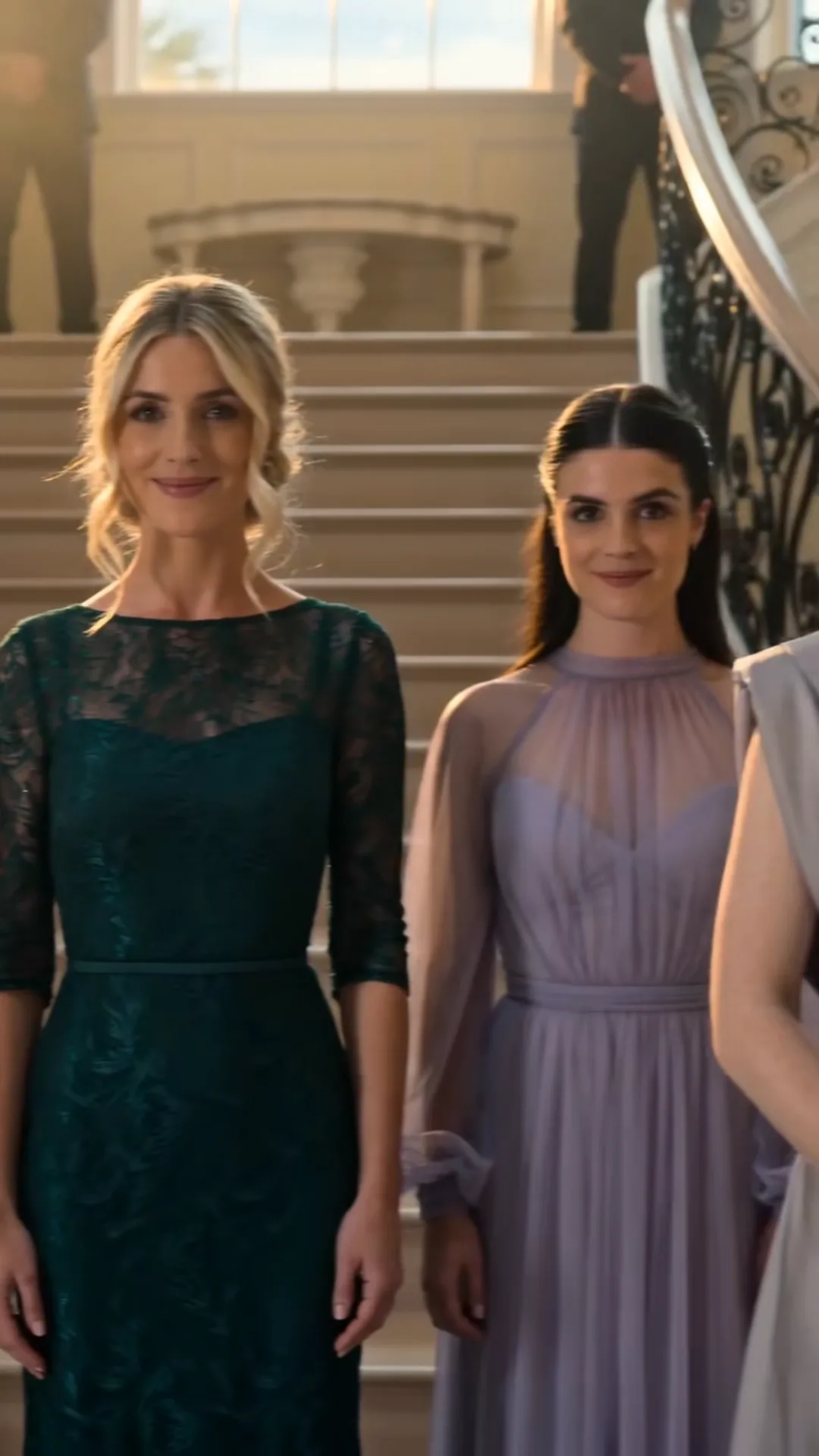
Chapter 1 - All Three

The marble in the Whitfield foyer was so polished it held a second chandelier, upside down, drowned in stone.
Julian Cross stood at the bottom of it.
Black suit. Black tie. Hands folded the way his father had taught him — loose enough to look calm, tight enough to hide that they weren't.
Richard Whitfield stood across from him, and beside Richard, in a neat row like items on a shelf, stood four young women.
Julian counted them once. Then again.
"Which one is your daughter?" he asked.
Richard smiled the way men smile when they are about to give away something they are proud of.
"All three," he said. "Madison. Lauren. Emily."
The camera of Julian's attention — if a man's eyes could be called that — moved across them one at a time.
Madison, in white, chin lifted like she'd been told her whole life that beauty was a posture.
Lauren, in black, a smile so practiced it had no seams.
Emily, gold silk catching the chandelier light, already glancing at Julian sideways to see if it was working.
Three smiles. Three sets of teeth. Three daughters, offered up like a hand of cards fanned open.
And then there was a fourth.
She stood half a step behind the others, in a dress the color of something left too long in shade — dark green, high collar, sleeves down to her wrists even though the room was warm. Her hair was red, the real kind, the kind that looks like it caught fire once and never fully went out.
Her hands were folded in front of her the same way Julian's were.
Except hers were shaking.
He hadn't asked about her. Nobody had introduced her. But he'd counted four, and he did not un-count things.
"You said you had three daughters," Julian said. "Didn't you?"
Something moved behind Richard's face — small, quick, like a fish under ice.
"Ah," he said. "Claire."
He said her name the way he might say umbrella stand, or side table — the name of an object whose function he remembered but whose presence he'd stopped noticing years ago.
"She's the child from my first wife," Richard went on, and here his voice dropped a register, into the tone reserved for things slightly beneath explanation. "She just stays around. To help with the housework."
Behind him, one of the guards shifted his weight. A chandelier crystal, disturbed by nothing at all, turned a slow degree and caught the light differently.
Claire did not move. That was the thing Julian noticed most — she did not flinch, did not protest, did not even really change her face. She had clearly heard this sentence before. Possibly this exact sentence, in this exact foyer, more than once.
What she did instead was look down.
Not dramatically. Not the way people look down in films, chin dropping to chest. She looked down the way a person looks down when they are recalculating, very quickly, how much smaller they are allowed to be in a room and still be allowed to stay in it.
Her eyes were wet. She did not let them spill.
Her hands — Julian noticed this too, filed it away without deciding to — her hands tightened in front of her, fingers laced so hard the knuckles went pale, like she was holding something invisible that might otherwise fall and break.
Madison exhaled through her nose. Not quite a laugh. The rehearsal of one, for later, when it was safe to actually laugh.
Lauren's smile didn't change at all, which was somehow worse.
Emily looked at Claire the way you look at a stain you've stopped seeing because you walk past it every day.
Julian said nothing for three full seconds.
Then he turned his head, slowly, and looked at Claire.
Really looked — the kind of look that has weight, that a person can feel land on their skin like temperature change. Claire's chin came up half an inch, involuntary, a reflex older than her manners. Green eyes, red-rimmed, met his.
For a moment neither of them looked away.
There was something in that half-second that did not belong to a business meeting between two families deciding the shape of a merger neither of the young people in the room had asked for. Something that belonged to neither the marble floor nor the chandelier nor the three smiling daughters arranged like a display case.
It belonged only to the two of them, and it lasted exactly as long as it takes a held breath to become unbearable.
Then Claire looked away first. She always looked away first. It was, Julian would come to understand, one of the only forms of control she had left — deciding, herself, when to stop being looked at.
Julian turned back to Richard.
His face had returned to its practiced neutrality, the mask his father called the boardroom face, the one that had closed nine-figure deals without once betraying what was actually going on behind it.
But something in his chest had shifted a half-degree, the way the crystal on the chandelier had, and did not shift back.
"Housework," he repeated, quietly.
He said it the way a man repeats a word he intends to remember.
Richard, mistaking the tone for amusement, allowed himself a short, satisfied laugh, and gestured toward the staircase, already moving on to the next item of business — the tour of the east wing, the numbers on the vineyard acreage, the terms his lawyers had drawn up weeks ago and were waiting, folded, in a leather portfolio upstairs.
Madison fell into step beside Julian on the left. Lauren took the right. Emily trailed slightly behind, already composing, in her head, the version of this moment she would tell her friends later — the one where Julian Cross had looked at her the longest.
None of them had noticed where his eyes actually went.
Claire did not follow up the staircase with the others.
She peeled off toward a side door half-hidden behind a marble column, the kind of door built for people whose job it was to be invisible — narrow, unadorned, no handle carved to match the ornate ironwork of the rest of the house. Just a plain brass knob, worn dull by a hand that used it every day.
Before she disappeared through it, she glanced back once.
Not at Richard. Not at her half-sisters.
At Julian.
He was already looking at the door.
Their eyes met for the second time in four minutes, and this time it was Julian who looked away first — not from discomfort, but because he understood, with the sudden clarity men like him rarely got to feel, that if he kept looking, everyone else in that hallway would see exactly what he'd already decided.
He climbed the stairs beside three women vying for his attention and thought of nothing but the fourth one who hadn't asked for it at all.
Behind the narrow door, Claire pressed her back against the frame, let out a breath she'd been holding since the word housework, and did not cry.
She had learned, a long time ago, that crying was a currency she could not afford to spend where anyone could see the exchange rate.
She smoothed the front of her green dress, picked up the laundry basket that had been waiting for her exactly where she'd left it that morning, and walked toward the kitchen stairs, back into the part of the house where chandeliers didn't reach.
She did not know yet that a stranger in a black suit had already decided she was the only person in that foyer worth looking at twice.
She would find out. Slowly. In small, unbearable increments, the way all real things arrive to people who have been taught not to expect them.
But for now, there was laundry.
May you like



There was always laundry.
---