Chapter 1 - The Girl Who Counted Steps
Elena counted steps.
It was a habit from childhood. Fourteen steps from the bus stop to the bakery. Six from the bakery to the alley where her mother sold flowers until midnight.
She counted because counting kept her hands still.
Still hands didn't shake when they were cold. Still hands didn't reach for things that weren't hers.
The marble staircase in the()Valderrama house had twenty-two steps.
She had counted them the first night, standing at the bottom in a borrowed coat, looking up at a chandelier that cost more than her mother had earned in a decade.
Alejandro had laughed at her, gently, the way he laughed at everything.
"You're doing the thing," he said.
"What thing."
"Counting. You count when you're nervous."
She hadn't denied it. There was no point denying things to a man who already saw through you and loved you anyway.
That was the beginning. Not the wedding. Not the ring. The staircase, and the counting, and a man who noticed.
---
Doña Renata noticed things too.
She noticed the scuff on Elena's shoes at the engagement dinner. She noticed the way Elena held her fork — tines down, European style, taught by a hospitality-school instructor who charged by the hour because Elena couldn't afford tuition any other way.
"She learned that from a book," Renata said to her sister, not lowering her voice, not caring that Elena stood four feet away holding a tray of canapés she'd insisted on carrying herself because standing still felt worse than moving.
"She learned that from a book, and she thinks it makes her one of us."
Elena set the tray down. Her hands did not shake.
She had learned, a long time ago, that the moment your hands shook in front of people like Renata, you had already lost.
---
Alejandro asked her to marry him on a Tuesday, in a parking garage, because his car wouldn't start and he panicked that the moment would slip away if he waited for something prettier.
"I don't have flowers," he said. "I don't have a plan. I have a car that won't start and a ring in my jacket that I've been carrying for six weeks because I kept losing my nerve."
"Ask me anyway," Elena said.
He did.
She said yes before he finished the sentence, and later she would tell people it was the parking garage she remembered — the smell of oil, the flickering fluorescent light, the sound of his voice cracking on her name — not the wedding itself, which came four months later and belonged, in every visible way, to his mother.
---
The wedding dress was white lace, high-necked in the photographs Renata approved and altered, off the shoulder in the photographs Elena kept for herself.
Renata called the alteration "common."
Elena wore it anyway.
"It's my wedding," she told Alejandro the night before, sitting on the floor of a hotel room because the bed felt too large for the size of her nerves. "Not a showroom for your mother's taste."
"She means well," Alejandro said, which was the sentence he always reached for, the way other people reached for a light switch in the dark. Automatic. Not quite true, but familiar enough to trust.
Elena didn't argue.
She had learned that too — which battles to fight, and which to let pass, folding them small enough to carry without breaking your back.
---
The house itself was older than three generations of Valderramas.
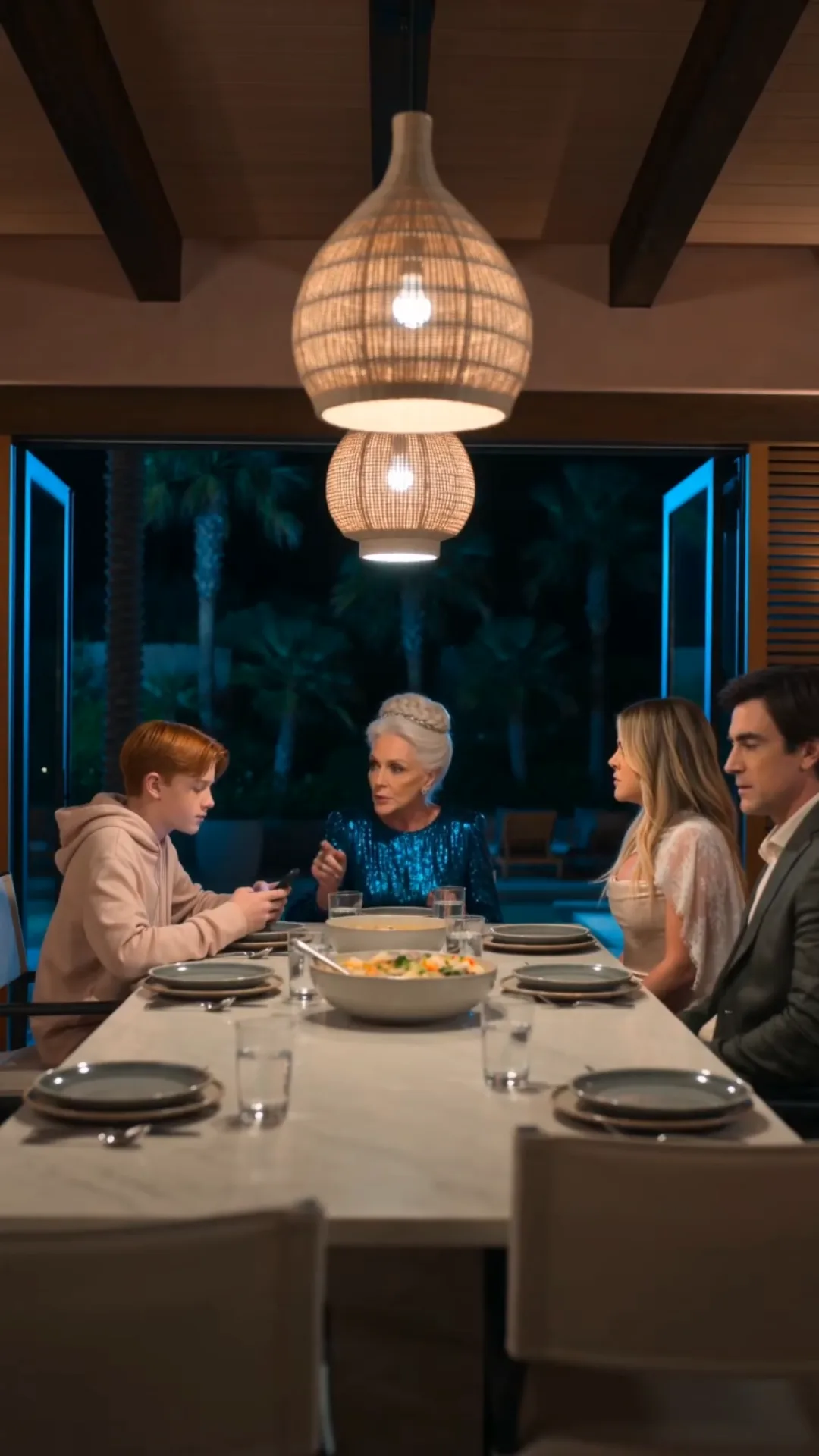
Marble floors that held the cold of December until March. A dining room with a table long enough to seat eighteen, though the family that ate there most nights numbered four. Windows at the back of the house, floor to ceiling, black glass at night that turned the room into a mirror, so that everyone at that table could always see themselves — and each other — reflected back, doubled, watching.
Elena moved in on a Sunday.
Renata had rearranged the guest wing "for practicality" — meaning Elena's room was three doors from the master suite instead of adjoining it, a detail Alejandro didn't notice and Elena filed away without comment.
Mauricio, Alejandro's younger brother, didn't attend the move-in. He sent a single text: welcome to the zoo.
Elena read it twice, deciding whether it was a joke or a warning.
She decided, correctly, that it was both.
---
Tomás was fifteen, technically Renata's grandson through a cousin's arrangement nobody explained clearly, raised in the house since he was seven because his own parents had "circumstances," another phrase nobody explained.
He looked up from his phone exactly once during the move-in, to say, "You can have my old bike if you want. Nobody rides it."
Then he looked back down.
It was the kindest thing anyone in that house said to her for six weeks.
---
The first months were quiet in the way a held breath is quiet.
Renata corrected Elena's Spanish, though Elena's Spanish was fine — it was her accent, carrying the flatter vowels of the neighborhood where she'd grown up, that Renata corrected, syllable by syllable, in front of guests.
"Say it properly," Renata would say. "You live in this house now."
"I say it the way I've always said it," Elena answered once, only once, and Renata's face did something complicated and cold, and after that Elena stopped answering at all.
Silence, she learned, made Renata angrier than defiance. But silence didn't give Renata anything to repeat at dinner parties, dressed up as concern. Poor girl, still adjusting.
So Elena chose silence, and paid for it in other ways.
---
Mauricio's cruelty was different. Quieter, and somehow louder for being quiet.
He watched her.
Not the way men sometimes watched women, though there was a version of that too, a version she avoided being alone with him long enough to name. He watched her the way an appraiser watches a painting he suspects is a forgery — waiting for the brushstroke that gives it away.
"You married well," he told her once, in the kitchen, close enough that she could smell the whiskey on him at four in the afternoon. "Better than well. You married up. Some people work their whole lives and never get what you got by saying two words in a church."
"I love your brother," Elena said.
"Sure," Mauricio said. "Sure you do."
He smiled when he said it, the kind of smile that wasn't a smile at all, just teeth arranged to look like one.
---
Alejandro traveled for work — three weeks a month, sometimes more, overseeing construction contracts in cities Elena had never seen and, increasingly, wouldn't see with him.
"Come with me," he said, the fourth time he packed a suitcase in two months.
"Someone has to survive your mother," Elena said, joking, though the joke had a hard center, like a stone inside soft fruit.
He kissed her forehead. "She'll come around."
Elena did not believe this. She had stopped believing it around the fortieth correction of her table manners, but she nodded, because nodding was easier than explaining that some people don't come around — they simply wait for their moment, patient as weather.
---
The old man — Alejandro's father, Don Rafael — died in March, eleven months after the wedding, in his sleep, in the master suite Elena had never once entered.
Elena had liked him. He was the only Valderrama who'd asked her real questions — about her mother, about the neighborhood, about whether she'd wanted to study something other than hospitality if the money had been there.
"Business," she told him once. "I wanted to run something. Doesn't matter what."
He'd smiled at that, a real smile, and said, "It matters more than you think."
She didn't understand what he meant.
Not yet.
---
At the funeral, Renata wore black lace that cost more than Elena's mother's flower stall made in a year, and cried in a way that looked, to Elena's eye, less like grief and more like performance rehearsed for an audience that mattered.
Mauricio didn't cry at all. He stood by the casket with his jaw tight, and once — just once — Elena caught him looking not at his father's face but at the study door down the hall, where Don Rafael's lawyer had disappeared an hour earlier carrying a leather folder.
Elena filed that look away too.
She was becoming, without quite noticing, a woman who filed things away.
---
The lawyer's name was Sr. Iglesias, and he requested — quietly, formally, three days after the funeral — a private meeting with Elena.
Alone.
"Just her?" Renata said, when the request reached the house, her voice pitched to carry. "What business could my husband's lawyer possibly have with the girl?"
Elena said nothing.
She had learned, by then, that the moments that mattered most were rarely announced with music.
They arrived quietly, in an envelope, on an ordinary Tuesday, and you only understood their size afterward, the way you only understand a wave's height once it has already pulled you under.
She went to the meeting.
She did not tell Alejandro, who was in another city, on another phone call, building something he would not live to fully understand had already been rebuilt underneath him.
She sat across from Sr. Iglesias in his office, hands folded, still, uncounting for once because there was nothing left in her body to steady.
He opened the folder.
"Mrs. Valderrama," he said. "There are some things your father-in-law wanted you to know. Things he asked me to hold until the right dinner. He was very specific about timing. He said—" the lawyer paused, adjusting his glasses "—he said you'd know it when you saw it."
Elena did not yet understand.
But something in her chest, quiet as a held breath finally released, told her that the counting was almost over.
That soon, she would not need to count her steps in this house.
She would own them.
---
May you like



(Continued in Part 2)
---