Chapter 4 - What the Ring Weighed
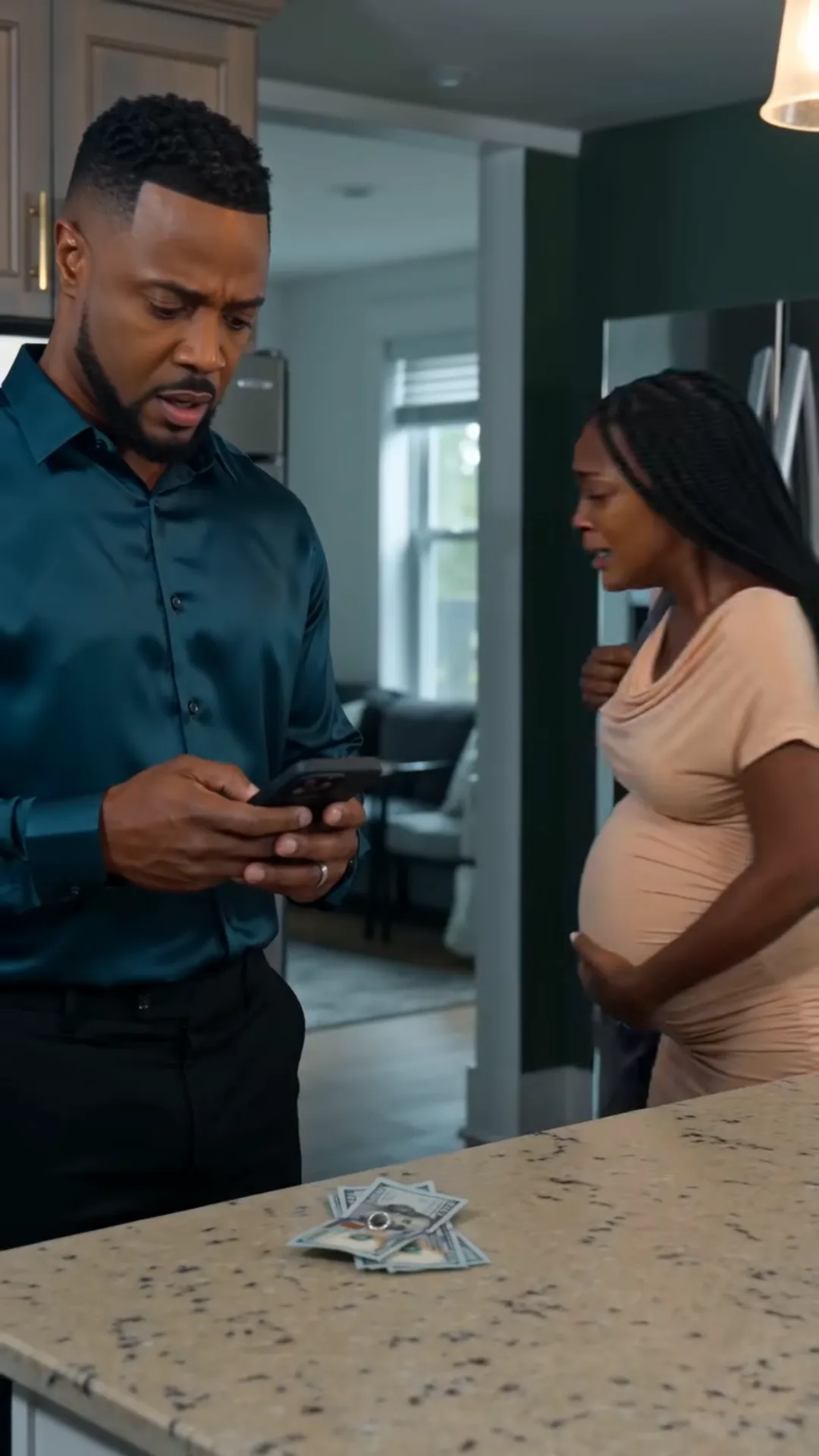
There is a particular kind of clarity that arrives only at the very end of hope — not dramatic, not explosive, but quiet, almost peaceful, the clarity of a decision that has actually been making itself for months, waiting only for the person to notice it was finished.
Emma felt it arrive in that kitchen, standing over a small folded stack of cash meant to cover a cab ride to the most important night of her life.
---
Her hand went, without her quite deciding it should, to her chest — pressing flat against her sternum, partly from the ache of another contraction beginning to build, partly from something else entirely, something that had nothing to do with labor and everything to do with the sudden, total collapse of a hope she'd been carrying, unexamined, for far too long.
Her wedding ring caught the kitchen light.
She looked at it for a long moment.
Four years. A garden. String lights. A version of Julian who had cried, actually cried, saying his vows, promising her a partnership, a team, a life built by two people facing everything, always, together.
She thought about the ultrasound he'd watched for four seconds.
She thought about the nursery he'd complimented from a doorway.
She thought about eleven months of practice contractions and real ones, both met with the same distracted, absent okay.
---
She pulled the ring off her finger.
It came easily — her fingers had swollen with the pregnancy, and the ring had been loose for weeks, sliding, she thought now, almost symbolically, closer and closer to simply falling away on its own.
She set it down, deliberately, on top of the folded bills.
Not thrown. Not flung in some dramatic gesture of rage.
Placed. Carefully. The way you set down something you have decided, finally, you no longer need to carry.
---
Julian didn't look up.
He was scrolling again, already three sentences deep into whatever email or headline had reclaimed his attention, entirely unaware that the small, precise click of metal against countertop, four feet away, was the sound of his marriage ending.
Emma looked at him for one long moment. Not with anger, exactly — anger would come later, in waves, over months of processing she hadn't yet begun.
In this moment, standing in the kitchen with a contraction building low in her belly, what she felt was closer to grief. Clean, total grief, the kind reserved for something you have already, secretly, been mourning for a long time before its actual death.
---
She picked up the grey duffel bag — the one she'd packed herself, three weeks earlier, folding tiny clothes with a hope she now understood had been, for months, entirely one-sided.
Her hand found the strap. Her knuckles went white around it.
She turned toward the door.
---
"I'll call you when I'm settled at the hospital," she said, and her voice came out steadier than she expected, steadier than she felt, carrying some new, unfamiliar strength she hadn't known, until this exact moment, that she possessed.
Julian glanced up, briefly, distractedly. "Sounds good. Tell them I'm coming after my call."
He didn't notice the bare finger holding the strap of the duffel bag.
He didn't notice, in that moment, anything at all.
---
Emma reached the doorway of the kitchen and stopped.
She turned back — one last look, though she didn't fully understand, in the moment, that it would be the last look for a very long time.
Julian stood at the counter, phone glowing blue against his face, utterly unaware that his wife, nine months pregnant and in active labor, was looking at him with an expression that held every version of disappointment a human face can carry — exhaustion, grief, disbelief, and, underneath all of it, something almost like relief, the relief of finally, finally stopping the exhausting work of hoping for someone who had stopped, a long time ago, doing the work of being present.
He didn't look up to meet her eyes.
She turned, and walked out of the kitchen, down the hall, past the nursery with its pale yellow walls and paper cranes, out the front door of the apartment she had spent four years slowly, quietly, disappearing inside of.
---
The hallway outside their apartment was cool and empty.
Emma leaned against the wall for a moment, breathing through another contraction, tears finally, silently, sliding down her face — not from the pain in her body, but from something that had been building far longer, something that had needed, apparently, exactly this moment to finally break loose.
She wiped her face. Adjusted her grip on the duffel bag.
And walked, alone, toward the elevator, toward a cab, toward a hospital, toward the beginning of a life she hadn't planned but was, in that exact moment, choosing anyway — a life without a man who counted out cash for her labor the way you'd tip a stranger for a service rendered.
---
The elevator doors closed behind her with a soft mechanical hiss.
In the mirrored panel, she caught her own reflection — sweat-damp hair, flushed face, one hand pressed protectively over her belly.
And, for the first time in longer than she could remember, something in her own eyes that looked, unmistakably, like resolve.
Whatever happens next, she thought, she will never once wonder if her mother fought for her.
She will only ever know that when it mattered most, I chose her.
---
The lobby was quiet at this hour — a doorman, half-asleep behind his desk, looked up in mild alarm as Emma crossed the marble floor, one hand braced against her lower back, breath coming in short, controlled bursts.
"Ma'am — are you alright? Should I call someone?"
"A cab," Emma managed, between breaths. "Please. I'm in labor."
The doorman moved fast, more present in thirty seconds than her husband had been in nine months, whistling down a cab from the curb, helping her into the back seat with careful, steady hands, asking, twice, if she wanted him to call anyone else.
"No," Emma said, settling back against the seat, both hands now cradling her belly. "Just the hospital. Please. As fast as you can."
The cab pulled away from the curb, and Emma closed her eyes, breathing through another contraction, and did not look back at the building she was leaving.
May you like



She was already, in every way that mattered, gone.
---







