Chapter 4 - One Bite
The word landed wrong.
Claire felt it before she understood why — a small flinch traveling down the table, Rachel's fork stopping halfway to her mouth, the birthday playlist still tinkling absurdly from the counter speaker into a silence that didn't belong to it.
Now.
Not cruel, exactly. Eleanor didn't mean it cruel. But it came out with the flat, commanding edge of a woman who had spent her whole life believing that love expressed as instruction was still love, that eat it, it's good for you, eat it, I made it for you, eat it, I need you to was simply what mothers — what grandmothers — said.
Emma's fork stopped in the air.
Her eyes went to Claire first — the automatic flick of a child checking whether an adult's tone is a real problem or a pretend one — and Claire, torn between not wanting to embarrass Eleanor and not wanting Emma to feel forced into anything, gave the smallest possible nod.
It's fine, baby. Just try it.
Emma looked back at the slice.
Chewed her lip.
And, because she was six, and because the woman across from her had a face doing something complicated and unhappy underneath its sternness, and because six-year-olds are frequently more perceptive about adult sadness than adults give them credit for, Emma decided the fastest way through this moment was simply to get it over with.
She put the bite in her mouth.
Chewed twice.
Swallowed.
"It's good," she said, a little too fast, the automatic reflex of a child reassuring a grown-up who needs reassuring. "It's really good, Grandma."
Eleanor's whole face changed.
The sternness dissolved. What replaced it was something almost unbearably soft — relief, gratitude, a flicker of David so strong in Emma's small approving nod that Eleanor had to look away for a second and press her lips together hard.
"I'm so glad," she said, voice not quite steady. "I'm so glad you like it."
Emma, having discharged her social duty, set her fork down and reached for her water cup instead, more interested now in the pile of unopened presents stacked by the window than in finishing the slice.
Nobody at the table noticed, in the small commotion of Rachel refilling drinks and the neighbor kids negotiating who got the corner piece of Rachel's cupcakes, that Emma's hand, resting on the table edge, had begun — almost imperceptibly — to tremble.
Nobody noticed that she touched her lips once, briefly, with the back of her wrist.
Nobody noticed the small crease that appeared between her eyebrows, the look of a child trying to name a feeling for which she doesn't yet have language, the specific itch-tightness-wrongness that had visited her exactly once before, in March, at a folding table covered in trail mix, a feeling she was too young and too newly acquainted with it to recognize twice.
Claire was three feet away, laughing at something Rachel said, not watching.
This is the part Claire would replay for the rest of her life. Not the collapse. Not the ambulance. This — the three feet, the laugh, the half-second she wasn't watching, though she had been watching all afternoon, though she had counted balloons twice and checked the candle drawer and done every single thing a good mother does except the one thing that would have mattered, which was asking a direct, specific, unambiguous question about a cake's ingredients before her daughter's fork ever touched it.
Emma pushed her plate an inch away.
"Grandma," she said, in a small voice that didn't carry over the party noise the way eat it, now had. "My mouth feels funny."
Eleanor, still glowing from the approval, from the small miracle of having fed her granddaughter something David loved, didn't quite catch the words at first.
"What was that, sweetheart?"
"My mouth." Emma touched it again. "It feels funny. Kind of — itchy."
"You probably just have crumbs," Eleanor said, reaching for a napkin, still smiling, still safely inside the version of this afternoon where everything was going right. "Here."
She wiped gently at the corner of Emma's mouth.
Emma flinched away — not from the napkin, but from something happening beneath her own skin, a sensation with no clear edges, spreading.
"It's not crumbs," Emma said, and her voice had changed now, thinned out, carrying the first true note of alarm any child's voice can carry, the sound that reaches a mother's ear from across a room even through music and chatter and forty other small sounds, because a mother's ear is built, evolutionarily, animal-deep, to isolate exactly that frequency from all the others.
Claire's head turned before she'd consciously decided to turn it.
"Emma?"
"Mommy." Emma's hand went to her throat. "I don't feel good."
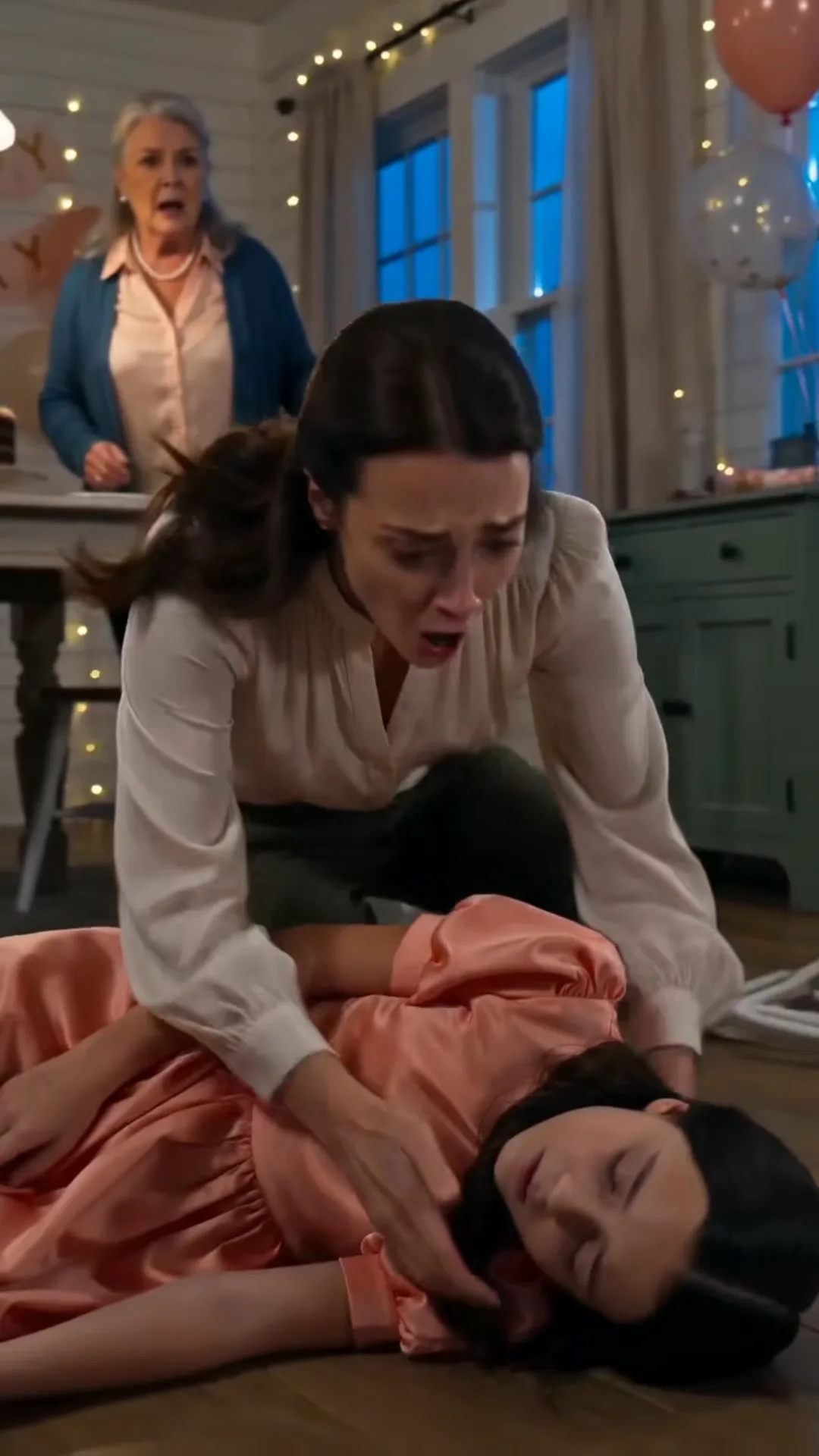
The room did not go silent all at once. It went silent in pieces — Rachel first, catching the shift in Claire's face and following her gaze; then the neighbor kids, sensing something wrong the way children always do, a half-beat behind the adults; then, last of all, Eleanor, who was still holding the napkin, still mid-motion, still living in the version of the afternoon where her cake was a gift and not yet, unbearably, a question.
Claire was already moving.
May you like



Three feet had never felt so far.
---







