Chapter 10 - The New Locks
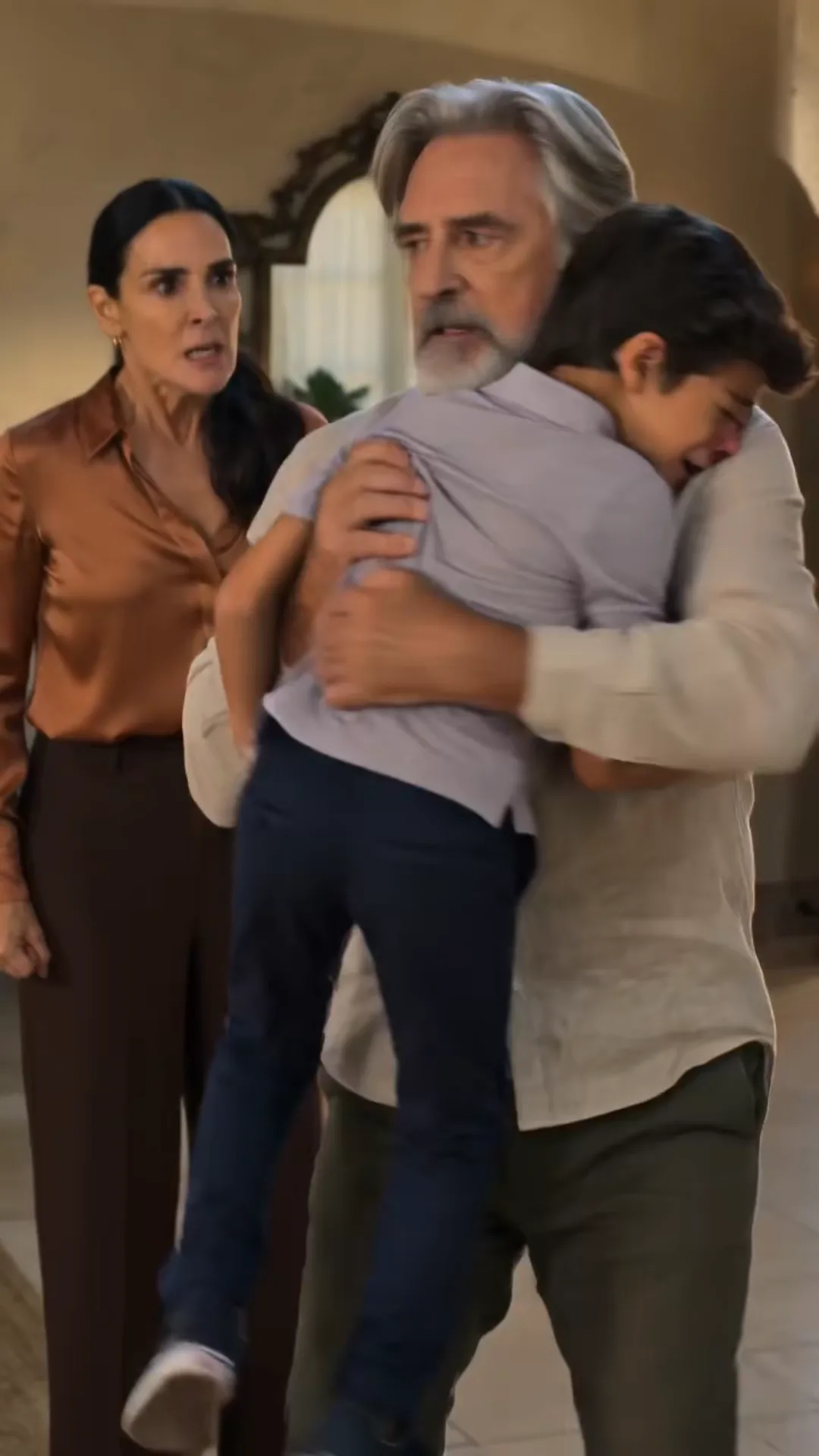
A year is a strange unit of measurement for a family rebuilding itself. Long enough for bruises to fade into nothing, short enough that the memory of them can still surface, uninvited, on ordinary afternoons for no reason anyone can predict.
Eli Bennett was nine now, and taller, and the new house he lived in with his father — a smaller house than the old one, with a plain wooden door and no curved staircase at all, which Eli had specifically requested during the one house-tour he'd been allowed real veto power over — had exactly the number of locks a nine-year-old boy needs to feel, each night, entirely certain of his own safety.
Three, to be precise.
He counted them every night before bed. Not out of fear this time. Out of a new, hard-won kind of ritual, one he had built for himself the way a person builds a small shrine to a hard-won peace.
Click. Click. Click.
"You don't have to check them every night," his father told him once, gently, not as a correction but as an offering, a door held open in case Eli ever wanted to walk through it toward something lighter. "They're not going anywhere. Neither am I."
"I know," Eli said. "I just like the sound."
This was true, in its way, though it was also not the whole truth, and Daniel — who had spent the last year learning, slowly and imperfectly, how to actually hear the things his son said rather than simply process them — did not push for the rest of it. He understood, by now, that some rituals exist not because the danger they guard against is still present, but because the body needs time to believe the danger is really gone, and rituals are how bodies buy that time.
Arthur came for dinner every Thursday, without fail, still smelling faintly of wherever his most recent trip had taken him, though he traveled less now, had handed most of the overseas negotiating to younger executives who did not have an eight-year-old — now nine-year-old — grandson who needed him closer to home.
He still asked the same question, every single visit.
"What did you find today?"
Eli's shoebox had grown into an actual wooden case Arthur had built for him over a long weekend, divided into small compartments, each stone and shell and bottle cap given its own labeled square, and the collection now numbered somewhere past forty, though Eli had stopped counting them competitively somewhere around thirty-one, once counting had finally, blessedly, stopped being a survival skill and started being simply a hobby.
He still counted other things, sometimes. Stairs, when there were stairs. Tiles, in unfamiliar bathrooms. The seconds between his father's car in the driveway and the sound of the front door.
But the counting had changed its character entirely.
He explained this once to Priya, the Tuesday-afternoon woman with the low table and the box of toys, in the particular unflinching language children sometimes use for enormous truths they have not yet learned to dress up in adult euphemism.
"I still count the stairs," he told her. "I used to do it because I was scared. Now I just do it because I like knowing the number. It's not the same thing anymore. It just looks the same from the outside."
Priya had written something down in her small notebook and told him that was one of the wisest things she'd heard a client say all year, adult or child, and Eli had gone home and repeated the compliment to his grandfather with an expression so proud it made Arthur have to excuse himself, briefly, to the kitchen, to compose his face before returning to the table.
There was, in the new house, no bowl of untouched lemons on the counter. There was, instead, a jar of the licorice candy Eli's mother used to keep in her car, which Arthur had somehow tracked down at a specialty shop three towns over and now kept quietly restocked without ever mentioning it, so that Eli could reach for one whenever he wanted without it becoming a whole conversation.
Some Saturdays, father and son and grandfather went to the river together, and Arthur taught Eli, finally and properly, how to skip a stone the correct way — wrist loose, angle low, the exact geometry his own father had taught him sixty years earlier on a different river, in a different country, in a version of his own childhood he rarely spoke about but which had clearly, in its own quiet way, taught him everything he now knew about showing up.
Eli was not, by the end of that year, a boy without scars.
The cut at his nose had healed into a thread-thin line, barely visible unless the light caught it at a particular angle, and the doctors had told them the knuckles would carry no lasting damage beyond that faint line either, though Eli sometimes still flexed his hands absently, checking, the way you check a bridge you once fell through, even long after it's been rebuilt.
The deeper marks — the ones no doctor could photograph, the ones Priya's low table and small notebook were built to slowly, patiently address — would take longer. Nobody in that new house, with its three good locks and its plain front door, pretended otherwise.
But on the last evening of that first full year — a Thursday, Arthur's usual night, the three of them finishing dinner at a table with no lemons and no swan-shaped lamp anywhere in sight — Eli looked up from his plate and asked his grandfather a question he had clearly been saving for the right moment.
"Grandpa. Do you think Mom would be proud of how I turned out? Even with — everything?"
Arthur set down his fork.
"I think," he said, choosing each word the way he had once chosen the words of contracts worth entire fleets of ships, "that your mother would look at a boy who survived something terrible, and still kept a rock collection, and still counts stairs just because he likes the number, and still asks hard questions at the dinner table because he trusts the people at it to answer honestly — I think she would say that's exactly the boy she always knew you were going to be. The hard year didn't make you. It just didn't manage to unmake you either. That's the part that matters."
Eli considered this with the same careful gravity he brought to everything, turning the sentence over the way he turned over a new stone before deciding whether it belonged in the case.
Then he smiled — the real one, the one that had taken most of a year to come back fully, the one that needed no rehearsal in any bathroom mirror — and reached for another piece of his mother's licorice candy from the jar his grandfather thought he didn't know was being quietly, endlessly restocked.
"A keeper," he said, holding it up the way you'd hold up a stone with a white ring around it.
Arthur laughed — a real, full laugh, the kind that had been rare in that family for longer than any of them wanted to admit — and across the table, Daniel reached over and rested a hand, light and steady, on his son's shoulder.
Outside, the evening settled over the small house with its plain door and its three good locks, quiet in the particular way that only follows a very long storm.
May you like



Nobody in that house needed to count the silence to know, finally, that it was safe.
— END —







