Chapter 8 - You Will Never Touch Him Again
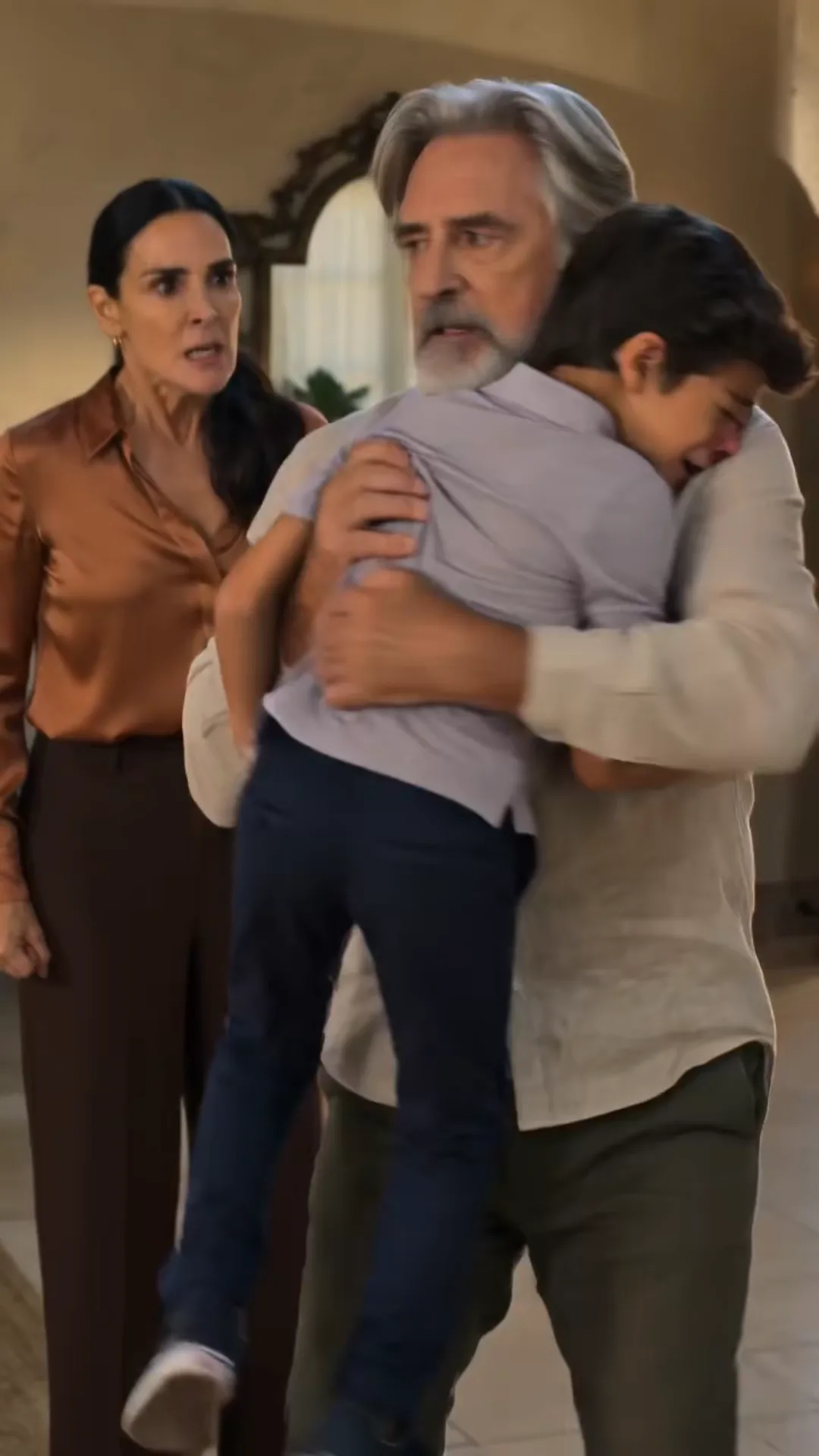
Later, when he tried to reconstruct it — for the lawyer, for himself, for the son who would arrive home two days after and demand to know exactly what had happened in his own front hallway — Arthur could not fully explain the half-second between Meredith's step backward and his own hand moving.
He would only ever be able to describe it the way you describe weather. A pressure system that had been building for two years, released all at once, in a single sharp discharge that left the air around it changed.
His palm connected with her cheek with a sound that seemed, in that hallway, far louder than a hand striking a face should reasonably be — a crack that bounced off the curved staircase and the swan lamp and the lying mirror and came back at all three of them, doubled, before it finally died away.
Meredith's head snapped sideways. She staggered, one hand flying up to catch the edge of the console table, and when she straightened again, a mark was already rising along her cheekbone, red first and darkening fast, the physical echo of the exact geometry of a hand.
For one suspended moment, nobody in that hallway moved.
Eli, on the stairs, had gone very still, his eyes wide, watching the mark bloom on Meredith's face the way you watch something you cannot yet decide how to feel about.
Arthur stood with his hand still raised, breathing hard, and something crossed his own face in that instant that had nothing triumphant in it at all — something closer to shock, the particular shock of a man discovering a version of himself he had not previously believed existed.
He lowered his hand slowly.
"You will never touch him again," he said. His voice shook, the first time it had shaken all morning, and the shaking made the words land harder than a steady voice could have managed. "Not once more, for the rest of his life. Do you understand me? You will not come near that boy. You will not call him. You will not write him a letter in ten years hoping he's forgiven you enough to answer it. Whatever this marriage was, it ends today, and whatever role you thought you had in raising my grandson ends with it."
Meredith did not answer. Her hand had come up to touch her own cheek, fingers trembling against the rising bruise, her face a mask of something too complicated to name in a single word — shock, and shame, and beneath both of those, unmistakably, a flicker of relief, the relief of a person who has been building toward a catastrophe for so long that its actual arrival feels almost like release.
Arthur turned away from her before she could speak, before the moment could curdle into an argument he had no intention of having, and crossed back to the stairs, kneeling in front of his grandson once more.
Eli was watching him with an expression Arthur had never seen on the boy's face before — not fear, exactly, though fear was certainly present, a lingering static charge left over from the last hour. Something else, underneath it. Something closer to a question.
"Grandpa," Eli said, very quietly. "Is it okay that you did that?"
It was, Arthur would think later, the single hardest question anyone had ever asked him, harder than any negotiation, any board meeting, any funeral eulogy he'd had to deliver in his long life, because it came from an eight-year-old boy trying, in real time, to build a moral architecture sturdy enough to hold both the man who had just rescued him and the violence that rescue had contained.
Arthur did not lie to him.
"No," he said. "It wasn't okay. I shouldn't have done it. Hitting someone is never the right answer, even when a person has done something terrible. I let my anger get bigger than my judgment, just for a second, and that's not something I'm proud of."
Eli's brow furrowed, working through this.
"But you did it because of me."
"I did it because I was scared, and angry, and I saw what happened to you, and for one second I forgot every rule I've spent my whole life trying to follow," Arthur said. "That doesn't make it right. It just makes it human. There's a difference between understanding why someone did something and saying it was okay that they did it. I want you to know both of those things at the same time. Can you try to hold both?"
Eli considered this with the particular gravity children bring to questions adults rarely trust them to handle.
"Like — you can be sorry and still be my hero," he said slowly. "Both at once."
Something in Arthur's chest broke open at that sentence, cleaner and more total than anything the last hour had managed.
"Yes," he said, his voice rough. "Exactly like that."
Behind them, Meredith had sunk onto the bottom step of the opposite staircase rail, one hand still pressed to her face, saying nothing, offering nothing, the fight and the fire of the last two years finally, entirely, spent.
Arthur did not look at her again for a long while. He had already said everything to her that this hallway required.
He reached into his coat pocket instead, hands still not quite steady, and pulled out his phone.
"I'm calling your father," he told Eli. "And then I'm going to call a doctor, just to make sure your hands are okay. Is that alright with you?"
Eli nodded.
"And after that," Arthur continued, keeping his voice level, keeping his eyes on his grandson's face rather than on the woman sitting silently across the hallway, "you and I are going to sit right here on these stairs, and you're going to tell me everything. Not because you're in trouble. Because it's finally safe to."
Eli's face did something then that it had not done, Arthur would realize only later, in what felt like a very long time — it opened, fully, without the careful architecture of smallness he had spent two years constructing.
"Everything?" Eli said. "Even the stuff I never told anyone?"
"Especially that," Arthur said. "That's usually the part that matters most."
Behind them, the sound of Meredith finally standing, gathering her coat with hands that would not quite stop shaking, filled the hallway's remaining silence. Neither of them turned to watch her go. There would be, in the days ahead, calls from lawyers and a caseworker and a police officer who would need Eli to say some of these same sentences again, more formally, into a recorder, in a small room with softer chairs than any room in this house had ever contained. There would be, further ahead still, court dates and paperwork and the particular slow bureaucracy that turns a single terrible morning into an official record — necessary, tedious, and entirely unglamorous compared to the single loud moment that had preceded it.
But all of that belonged to later.
Right now there was only a boy on a staircase, an old man kneeling in front of him, and the first honest conversation either of them had been allowed to have in longer than either could remember.
"Where do I start?" Eli asked.
"Anywhere," Arthur said. "We've got time. We've got as much time as you need."
May you like



And for the first time in two years, that sentence was actually, provably true.
---







