Chapter 10 - What the Stairs Remember
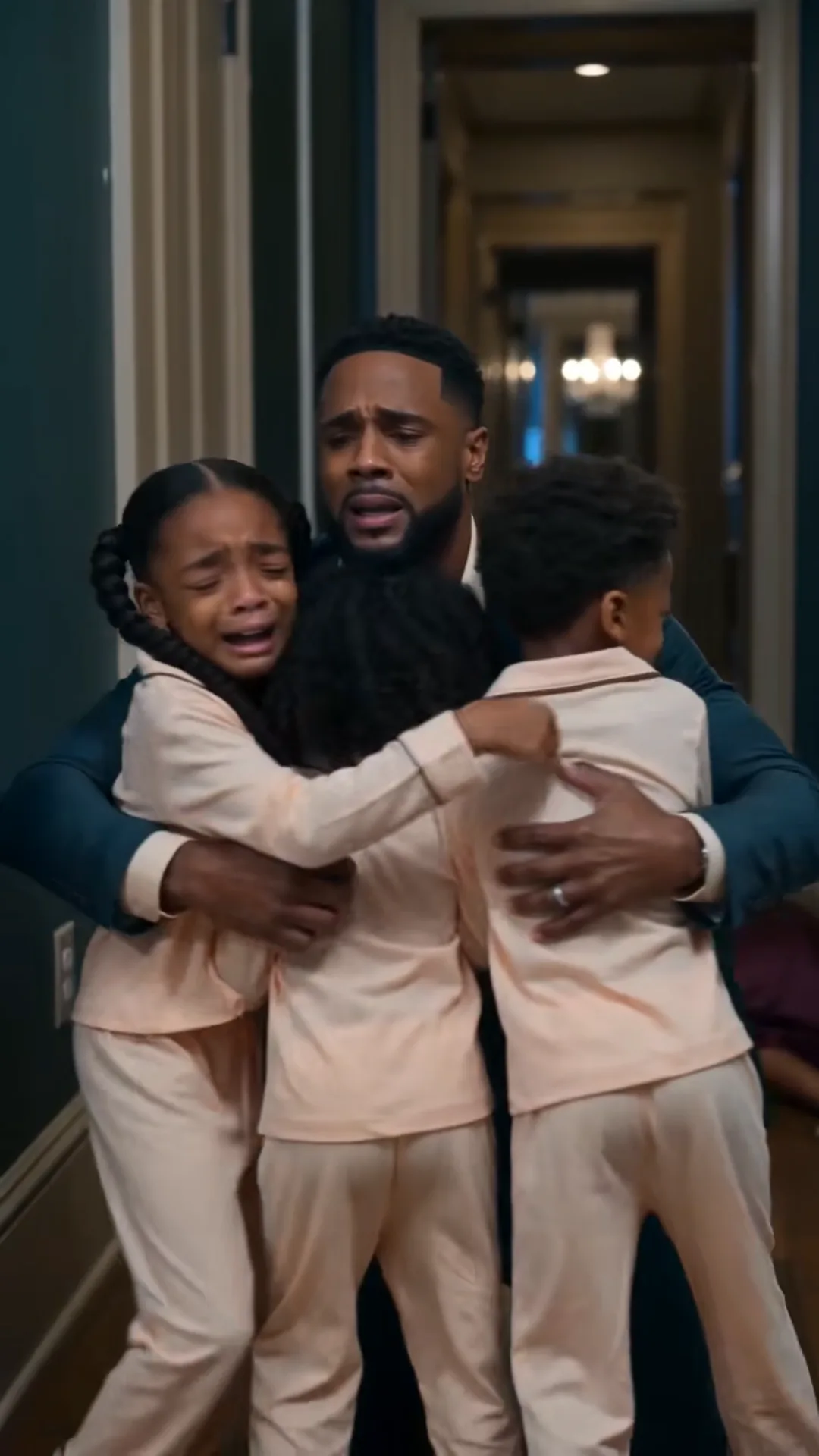
A year is a strange unit of time to a child.
To Mia, six now, a year was an entire geological age — long enough that the old house had become a half-remembered shape, more feeling than photograph, the memory of it softened at the edges the way memories do when a child's brain, mercifully, decides some things are better filed under long ago than last year.
To Leo, eight, a year meant a new shoelace he tied himself every morning without complaint, a birdhouse now weathered and nailed to a tree in the small courtyard behind the apartment, a robin's nest inside it that he checked every day like it was his personal responsibility, which, in his mind, it absolutely was.
To Emma, nine, a year meant something different.
A year meant she had stopped needing to unfold the crayon drawing every week.
She still kept it. In a shoebox now, with other things — a movie ticket, a rock Leo had given her because he thought it looked "extra normal," a birthday card from her mother that had arrived on time this year, no missed date, no excuse.
She didn't need to look at the drawing to remember what it said.
I hope it stays like this.
She understood now, in a way her eight-year-old self hadn't quite had language for, that hope isn't a guarantee. It's just a direction you keep facing, even when the road curves somewhere you didn't plan for.
---
Renata had an apartment ten minutes away now.
Small, plants on every windowsill, a framed photo on the bookshelf of three kids at a birthday party, taken during a supervised visit eight months ago, everyone smiling in the specific careful way people smile when they're still learning to trust the moment enough to let their face relax into it.
The visits weren't supervised anymore.
That had taken eleven months, four caseworker reports, two relapses that hadn't turned violent but had still meant a hard reset on trust, and one very long night where Renata had called her sponsor instead of calling anyone in her family, because she had finally learned the difference between a crisis that was hers to carry alone and a crisis that had no business landing on her children's shoulders.
Daniel didn't know if he would ever call her his wife again, not in the way that word used to mean.
But he had stopped, sometime around month nine, needing her to be his enemy in order to keep his children safe.
Those were two different projects, he'd finally learned. Safety didn't require hatred to sustain it. It just required boundaries, clearly drawn, consistently held, revisited whenever the ground shifted.
---
On a Sunday in early autumn, thirteen months after the hallway, all five of them stood in the small courtyard behind Daniel's apartment, looking up at the birdhouse.
The robin's nest was empty now — the fledglings long gone, off into whatever version of their own ordinary lives birds get to have — but Leo still checked it daily, out of habit, out of something like loyalty to a home he'd helped build with his own hands.
"Can we build another one?" Mia asked. "A bigger one. For a bigger bird."
"What kind of bigger bird?" Emma asked, amused despite herself.
"I don't know. A safe one. A big safe bird that needs a big safe house."
Nobody corrected the strange, beautiful logic of that sentence.
Daniel just crouched down to her height, the way he had in a hallway that felt, some days, like it belonged to a different family entirely, and said, "Yeah. We can build a bigger one. We've got time."
---
Renata watched from a few feet back, hands in her jacket pockets, not stepping fully into the moment — she had learned, in therapy, in the group sessions, in the slow unglamorous work of rebuilding a version of herself worth trusting, that some moments belonged to the children first, and that her job now was to wait to be invited in rather than assume a place at the center.
Emma noticed her hesitating.
Walked over. Stood next to her instead of in front of her, which had once, in a different hallway, been the position of a body trying to be a wall.
This time it wasn't a wall.
It was just a daughter, standing beside her mother, watching her siblings argue about bird sizes in the afternoon light.
"You can come closer," Emma said. Quiet. Not an easy sentence, even now, even after everything. But true, and offered honestly, which was the only kind of sentence that had ever mattered in that family, from the very first please in that hallway to this one.
Renata's eyes went bright, fast, the specific brightness of someone trying very hard not to make her own healing someone else's burden to manage.
"Okay," she said. Just that.
And walked the few remaining feet across the courtyard grass, toward her children, toward the birdhouse, toward whatever slow, imperfect, unglamorous version of a family this particular group of five people had decided, one difficult year at a time, they were still willing to keep building.
---
That night, long after the kids were asleep, Daniel stood at his window and looked out at the courtyard, empty now, the birdhouse a small dark shape against the fence line.
He thought about the stairs.
The old ones, in the old house — sold now, to a young couple who had no idea what those gray steps had witnessed, no idea that a chandelier had once thrown its gold light across a father running faster than he'd ever run in his life.
Houses don't remember, not really.
But people do.
Emma would remember the please she'd said into a dark hallway, and the please she'd learned, later, to say for smaller, safer things — please pass the salt, please can I stay up ten more minutes, please ordinary requests that carried no danger in them at all.
Leo would remember the shoelace, and the birdhouse, and the specific relief of a father who never again let more than a minute pass between hearing trouble and arriving to meet it.
Mia would remember almost nothing consciously, and that, too, was its own kind of mercy — a childhood eventually thick enough with ordinary, boring, birdhouse-building days that the bad night got buried under all the good ones stacked on top of it, the way a scar eventually sits quiet beneath healthy new skin.
And somewhere, in a small apartment across town, a woman who had once raised a bat in a dark hallway now kept a framed photo on her bookshelf of three kids smiling, carefully, honestly, at a birthday party she'd been allowed to attend.
Not because she'd earned forgiveness in full.
Because she'd earned the right to keep trying, one supervised visit, one Thursday phone call, one difficult honest sentence at a time.
That was the story's real ending, if it needed one.
Not a rescue, tidy and complete, the credits rolling the moment the bat hit the floor.
May you like



Just the slow, unglamorous, entirely ordinary work of people learning — one birdhouse, one shoelace, one folded crayon drawing at a time — how to build something worth calling home again.
— END —







