Chapter 3 - Please, Emma
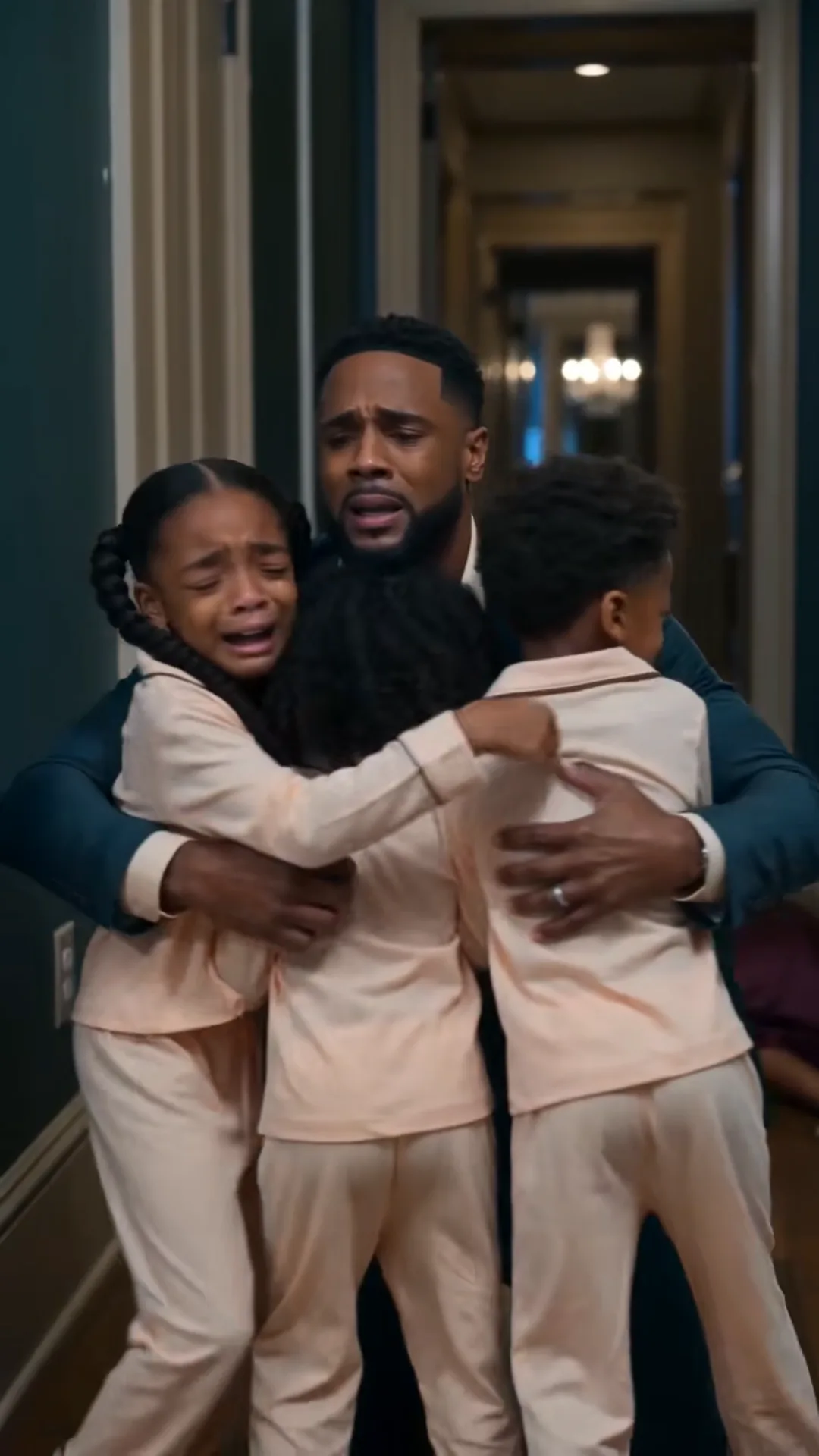
Fear has a smell.
Nobody tells you that until you're standing close enough to it to learn.
It smells like sweat gone cold, and something metallic underneath, like a coin held too long in a closed fist.
That was the smell in the hallway.
Three children breathing it in, learning it, the way you learn any smell that visits you enough times — until your body starts flinching before your mind even catches up.
---
Leo's grip tightened again.
He had run out of new ways to hold his sisters, so he just held them the old way, harder.
His mother's silhouette swayed, just slightly, the bat still raised, her breath coming out in short punches of air.
He watched her hands.
Kids learn to watch hands the way sailors learn to watch a sky. Hands tell you the weather before the weather arrives.
Her hands were shaking, but they weren't lowering.
That was the part that scared him more than anything else. Shaking hands that don't lower.
---
Mia lifted her face from Leo's shoulder, just an inch, just enough to see her mother's shoes.
Not her face. Mia had learned, without anyone teaching her, that looking at faces during moments like this only made the moment sharper.
Shoes were safer. Shoes didn't yell.
The shoes were cream-colored flats, a small stain near the left toe from spaghetti sauce two nights ago, back when the kitchen had smelled like garlic and something almost, almost normal.
Mia stared at that stain like it was the only true thing left in the world.
---
"*Por favor,*" Emma said again.
Please.
Her voice cracked in the middle of the word, the way a plate cracks — not shattering, not yet, just a fault line appearing, promising a shatter that hasn't happened but absolutely will, given enough pressure.
"*No le pegues a Emma,*" Mia whispered into Leo's shoulder, not lifting her face this time.
Don't hit Emma.
She wasn't even talking to her mother.
She was talking to no one. To the air. To whatever version of fairness a five-year-old still believes might be listening, somewhere, if she says the right words quietly enough.
---
There is a kind of child logic that adults lose access to somewhere around adolescence, when the world teaches them that words don't actually rearrange outcomes, that please and sorry are just sounds and not spells.
Children haven't learned that yet.
Mia still believed, with the whole unbruised part of her heart, that if she said sorry enough times, in the right order, with the right amount of crying attached, the bad thing might reverse itself.
That's not naivety.
That's hope wearing its very first disguise.
---
Emma stepped half an inch forward.
Not brave. Not exactly.
More like — someone had to be the one standing closest to the bat, and she had decided, somewhere beneath conscious thought, that it was going to be her.
The oldest child develops a strange arithmetic early. A silent equation that says: if I take more, they take less.
Nobody assigns that math homework.
Kids just start doing it, on their own, in houses like this one.
---
"You don't have to," Emma said. Not in Spanish this time. In English — the language she used, sometimes, when she was trying to speak past her mother, straight to whatever tiny reasonable version of her might still exist somewhere underneath.
"We'll be quiet. I promise. We'll be so quiet."
The bat trembled.
For one breath — one single breath — something almost shifted in the woman's face. A flicker. A memory of who she used to be before whatever storm had taken up permanent residence behind her eyes.
Then it was gone.
Storms don't leave because you ask nicely.
"*Cállate,*" she said. Be quiet.
But her voice had changed. Something underneath the anger had started leaking through — something that sounded, if you listened closely enough, almost like grief.
Grief and rage sometimes wear the exact same coat.
Children can't always tell them apart. They just know both of them hurt.
---
That was when the front door, thirty feet back down the hall, forgotten in all of this, clicked.
Nobody in the hallway heard it.
They were too far inside the moment to hear anything but their own held breath.
But it clicked.
Somewhere behind them, past the staircase, past the chandelier throwing its spilled-gold light — the world outside this hallway had just found its way in.
The bat rose another inch.
Emma closed her eyes.
Not in surrender.
May you like



In the specific, quiet bravery of someone who has decided that if this is coming, she would rather not watch it arrive.
---







