Chapter 1 - The Thirteenth Stair
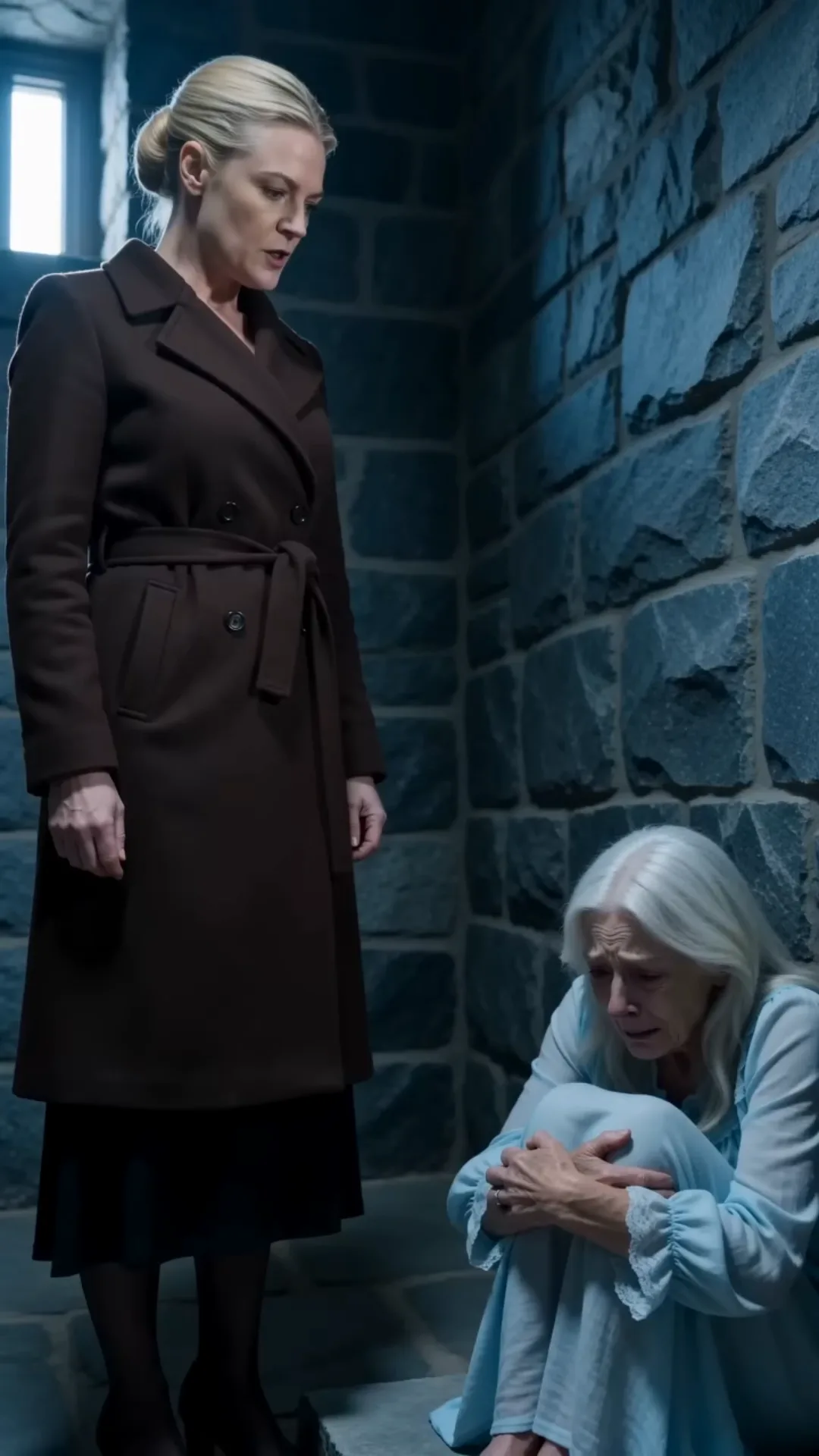
Lucas counted stairs.
He always did. It was a habit, like counting cracks in the sidewalk, or counting how many times his mother blinked before she lied.
Twelve stairs to the kitchen.
Twenty-four to his bedroom.
And thirteen — down, down, down — into the dark.
He had never gone past the door at the bottom before. The door was old. Iron hinges. A bolt as thick as his wrist.
Tonight it was open.
Just a crack.
Just enough for cold air to breathe out into the hallway, curling around his bare ankles like something alive.
He stopped on the ninth stair.
He heard his mother's voice first. Not the voice she used at dinner parties, syrupy and bright. A different voice. Flat. Hard. The voice of someone stepping on an insect and not looking down.
"You will stay in this basement, old woman."
Lucas's hand tightened on the railing.
"Until you learn to be grateful."
He took the tenth stair.
The eleventh.
Through the crack in the door, he saw a wedge of grey stone floor. A sliver of red wool coat. His mother's shoes — the sharp black ones, the ones that clicked like a clock counting down something.
And past her shoulder, low on the ground, a shape.
White hair. Bare arms wrapped around bare knees.
Grandma Eleanor.
Lucas had been told she was resting. Told she was at a special clinic upstate. Told, three days ago at breakfast, that she had gone to stay with cousins in the city, and wasn't that nice, sweetheart, eat your eggs.
He had believed it the way children believe things — not because the evidence supported it, but because the alternative was too large to hold in two small hands.
Now the alternative was six feet away, shivering on a stone floor.
"Please," Grandma Eleanor said. Her voice cracked down the middle like an old plate. "Vivienne. Please. My medicine—"
"You don't need medicine." His mother's tone did not rise. It never rose. That was the worst part — the terrible evenness of it, like she was reading a grocery list. "You need to remember your place in this house."
Lucas's grandmother made a sound then.
Not a word. Not quite a sob either.
A sound like something folding in on itself.
Lucas backed up one stair. The wood groaned under his heel — a small groan, a mouse-sized groan — but in the silence of the stairwell it might as well have been a shout.
His mother's head turned.
He froze on the twelfth stair, one hand still on the railing, his heart going off like a firework trapped in a jar.
The door swung wider. His mother's face appeared in the gap — perfect, powdered, furious. Her eyes found him in half a second, the way a hawk finds a field mouse from three hundred feet up.
"Lucas."
"I was thirsty," he said. The lie came out smooth. He was learning. Seven years old and already fluent in the family dialect.
His mother studied him. Something moved behind her eyes — calculation, maybe, or warning — before it smoothed itself into a smile.
"Go back to bed, baby."
"Okay, Mommy."
He did not move.
"Now."
He went. Thirteen stairs, in reverse, each one louder in his ears than it had ever been before. At the top he did not go to the kitchen for water. He sat down against the wall outside his bedroom door, knees pulled to his chest, in almost the exact shape his grandmother had been holding herself downstairs, and he stayed there until he heard the iron door groan shut far below, and the bolt slide home with a sound like a small, final punctuation mark.
*
He did not sleep.
He lay in bed with his eyes open, tracing the crack in his ceiling that looked, if you tilted your head, like a river on a map.
Grandma Eleanor used to trace that same crack with him. She used to sit on the edge of his bed with her reading glasses pushed up into her white hair and tell him it was the Amazon, or the Nile, depending on her mood, and that somewhere along it there were boats full of people looking for treasure.
She used to smell like lavender soap and peppermints.
Tonight she smelled like nothing, because Lucas had not gotten close enough to smell her at all. He had only seen her from nine stairs up, through a six-inch gap in an iron door, shivering on stone in a white nightgown that used to be his grandfather's favorite — she'd told him that once, that her husband loved her best in white, and that was why she still wore it, years and years after he was gone.
Lucas thought about that now. About a dead man's favorite dress, on a living woman freezing on a floor.
He got up.
He padded down the hallway in sock feet, past his parents' closed door, past the tall window where the garden lay blue and silver under a half moon. He went to the linen closet and took the smallest blanket he could find — a soft yellow one, the one he'd had since he was a baby, the one with a duck embroidered in the corner, worn thin from love — and he folded it as small as it would go and tucked it under his arm like a football.
He did not go down the stairs. Not tonight. He had used up his luck for one evening; even a seven-year-old understood the economics of that.
Instead he went to the small window at the end of the hall, the one that looked down over the side of the house where the basement's single narrow vent let out into the garden, half-hidden behind a rosebush his mother was very proud of and pruned, viciously, every spring.
He opened the window.
He dropped the blanket.
It landed in the rosebush, snagged on thorns, a small yellow flag against the dark green leaves — not through the vent, not anywhere near where it needed to be, really, but it was there, it was something, it was a seven-year-old's entire understanding of rescue folded into cotton and thrown out a window at midnight.
He watched it hang there a long moment, swaying slightly.
Then he went back to bed and lay very still and did not cry, because crying was for daytime, when someone might hear you and ask why, and he did not yet have an answer that wouldn't get him in trouble, or get her in worse trouble, or both.
*
In the morning, the blanket was gone from the rosebush.
Lucas did not know if the wind had taken it, or if his mother had found it and thrown it away, or — and this was the thought he held onto hardest, turning it over and over like a smooth stone in his pocket — if somehow, impossibly, it had found its way to the vent, and through the vent, and down into the cold, and onto a pair of thin shivering shoulders.
He never got the chance to ask.
May you like



Because that was the morning the maid found out, too.
---