Chapter 10 - What the House Remembered
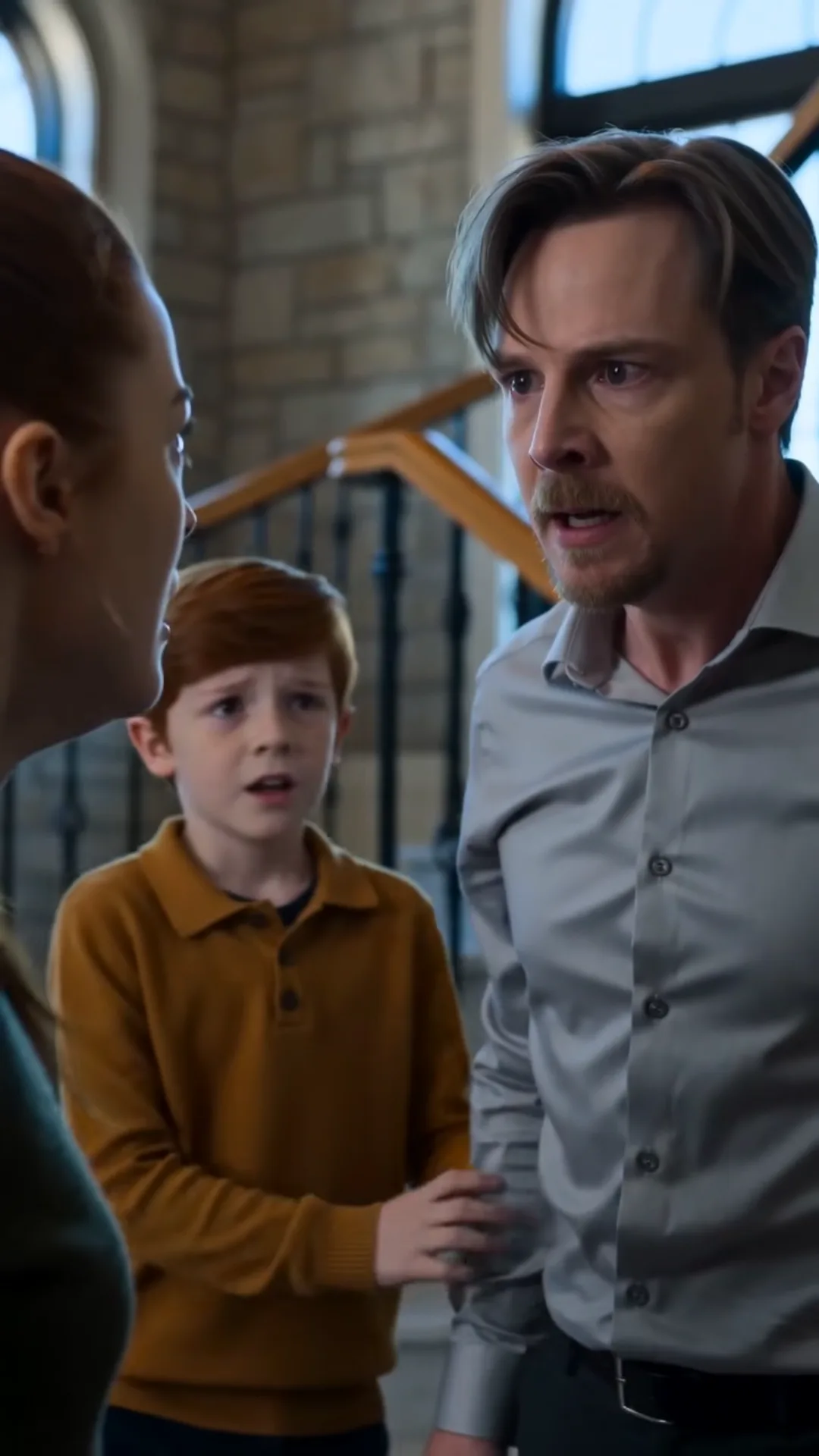
Margaret Hale woke up on the second day, in a hospital room smelling of antiseptic and the cheap lavender hand lotion the nurses kept by the sink, and the first thing she said, before she asked about her ribs or her wrist or the stitches she could feel pulling at her scalp, was: "Where's Justin?"
He was in the chair by the window, where he had been for most of the last eighteen hours, refusing, gently but with total nine-year-old immovability, every suggestion that he go home and sleep.
"Right here, Nana."
"Good," Margaret said, and closed her eyes again, and for a moment Daniel, standing at the foot of the bed, thought she'd drifted back under. Then she added, without opening her eyes, in a voice already sharpening back toward its usual clarity despite the concussion and the drugs, "Somebody's going to have to tell me what happened. All of it. Don't leave anything out because you think I'm too fragile. I built a shipping company out of a hardware store. I can handle a staircase."
So Daniel told her.
He told her about the wax, and the fabricated phone call about Ellery's office, and the bag behind the towels that a police technician had since removed in a sealed evidence bag, its contents — Margaret's real blood pressure medication swapped, over months, with pills that mimicked its appearance closely enough to survive a glance but not closely enough to do what the real ones did — sent for analysis that would, three weeks later, confirm every one of the small, dizzying symptoms Margaret had attributed, over the preceding months, to age.
The fogginess she'd mentioned to her doctor in March.
The two times she'd forgotten, briefly and frighteningly, the name of a street she'd lived near for thirty years.
The exhaustion that had made her, more than once, cancel plans she'd normally never have canceled, plans with Justin, plans she'd later apologized for missing without understanding, even slightly, that the apology should have run in the other direction.
"She was making me doubt myself," Margaret said, when Daniel finished, and something in her voice — not fear, but a kind of cold, retrospective fury — made Justin, in his chair by the window, look up sharply. "For months. She wanted me confused enough that if I ever did finalize the trust, there'd be a lawyer somewhere ready to argue I didn't know what I was signing."
"She's confessed to all of it," Daniel said. "The DA's already talking about attempted murder in addition to the assault charge. Ellery thinks the medication tampering alone is enough for elder abuse charges on top of everything else."
Margaret was quiet for a long moment, looking not at her son but at her grandson, who had gone very still in his chair, listening to a legal vocabulary far beyond his years being applied to the woman who had, for three of them, been the only mother he could remember with any clarity.
"Justin," she said. "Come here."
He came and stood beside the bed, and Margaret reached out with the hand that wasn't in a cast and took his, her grip weaker than usual but steady.
"You saved my life," she said. "You understand that, don't you? Not the pushing — that had already happened by the time you saw it, that part was done. But everything after. If you hadn't said what you saw, when you said it, the way you said it — plainly, and again, and again, no matter how many times a grown-up tried to talk you out of your own eyes — I don't know what would have happened next. I might have woken up in this bed to a story about a slip on wet marble, and believed it, because everyone else in the house would have agreed to believe it too."
"I just said what I saw," Justin said, with the particular discomfort children have when praised for something that felt, to them, less like heroism and more like the only available option.
"That's the whole thing," Margaret said. "That's the entire, enormous thing. Most people, faced with a version of events that would be so much easier to accept, choose the easier version. You didn't. At nine years old, with your father grieving in front of you and a woman you'd lived with for three years telling you that you'd misunderstood what your own eyes had shown you — you didn't."
She squeezed his hand, wincing slightly at the movement, and looked past him to Daniel.
"He's not a witness in this family anymore," she said. "He's the only reason this family has a future worth talking about."
---
The trial, when it finally came, eight months later, was mercifully brief, mostly because Elena's lawyer, faced with a nine-year-old's unwavering testimony, a confirmed sample of tampered medication, a recorded phone call Renata's own guilty conscience had eventually driven her to hand over to police, and a housekeeping schedule that placed Elena, and only Elena, at the stairs on the morning in question, advised his client to accept a plea rather than roll the dice with a jury.
She pled guilty to attempted murder, elder abuse, and assault, and was sentenced to eighteen years, of which — the judge noted dryly, reading from the file — she would likely serve something closer to twelve given the plea.
Daniel filed for divorce the week after the incident, not the week after the trial; there had been, from the moment his hand connected with his wife's face in that front hall, nothing left in him to wait for.
Renata was never charged with anything beyond obstruction, a plea deal of her own in exchange for the recording and her testimony, though the sisters would not speak again for years, and when they finally did, it would be through the glass partition of a visiting room, a conversation neither of them would ever fully describe to anyone else.
The house changed, in the months that followed, in ways too small to name individually but impossible to miss cumulatively.
Daniel had the stairs re-marbled entirely — not repaired, replaced, a decision the contractor found excessive for a floor with no structural damage, but one Daniel would not be talked out of. New stone. New railing, wider this time, more visible, installed at a height that made it genuinely useful rather than decorative, though he never said out loud, to the contractor or to himself, exactly whose habit of ignoring railings he was quietly correcting for.
Margaret, once her ribs healed and her wrist came out of its cast, took to using the new railing every single time, without exception, a small daily surrender of the pride that had nearly cost her everything, though she would occasionally joke, dryly, that she'd earned the right to a little more caution in her old age.
Justin went back to school two weeks after the incident, and for a while his teachers reported a boy who was quieter than usual, more watchful, prone to noticing things — a classmate's forced smile, a teacher's evasive answer — with an attentiveness that unsettled adults who weren't used to being read that closely by a nine-year-old.
But children are, in the end, more resilient than the houses they grow up in, and over the following year, slowly, the watchfulness settled into something less anxious and more simply observant — the making of a boy who would grow, everyone around him agreed, into an adult unusually difficult to lie to, a trait that would serve him, in ways none of them could yet imagine, for the rest of his life.
He kept, for a long time afterward, a single small habit he never explained to anyone and no one thought to ask about: every time he walked past the new staircase, on his way up to his room or down to breakfast, he would rest one hand, briefly, on the railing his grandmother had once refused to use — not because he needed it for balance, but because the weight of his palm against the cool metal seemed, to him, like a kind of promise, made silently and privately, that he would always, for the rest of his life, trust what he saw with his own eyes over what anyone, however convincingly, told him he should have seen instead.
---
Margaret sat on the back porch one evening in early spring, six months after the fall, watching Justin do cartwheels across the lawn with the reckless, joyful abandon of a boy who had, for a while, forgotten how to simply be ten years old, and had only recently begun to remember.
Daniel brought her tea, sat beside her, and for a while neither of them said anything at all, the comfortable silence of two people who had survived something together and no longer needed to discuss it constantly to prove they had.
"You know what I keep thinking about," Daniel finally said.
"Tell me."
"The lawyer's word. 'Provisional.' You signed a week early because you didn't trust the twelve days in between. And it still almost wasn't early enough."
Margaret watched her grandson tumble sideways into the grass, laughing at his own failed cartwheel, entirely unbothered by his lack of grace.
"There's no version of it that would have been early enough," she said, "if someone in the house had already decided, in her heart, to make sure it never mattered when I signed at all. The paper was never really the danger, Daniel. The paper was just the excuse."
"Then what was the danger?"
Margaret considered this for a long moment, watching the last of the light catch gold in the arched window behind them, the same window that had watched over a marble staircase both old and new, both treacherous and, now, finally, safe.
"Someone deciding that what they wanted mattered more than what was true," she said. "That's the only danger that's ever mattered, in any house, in any family, in any staircase anyone's ever fallen down. Everything else is just the shape it happens to take."
Justin, hearing his name called for dinner, sprinted across the lawn toward them, breathless, grass-stained, grinning, and threw himself into the space between his father and his grandmother on the porch swing with the complete, unthinking trust of a child who had, against every reasonable expectation, come out the other side of the worst day of his life still fundamentally certain that the people around him would tell him the truth.
It was, Margaret thought, watching him settle between them, breathing hard, alive, entirely unbroken — it was the only inheritance that had ever really mattered.
May you like



Everything else, in the end, was just paper.
THE END







