Chapter 7 - What the Boy Said
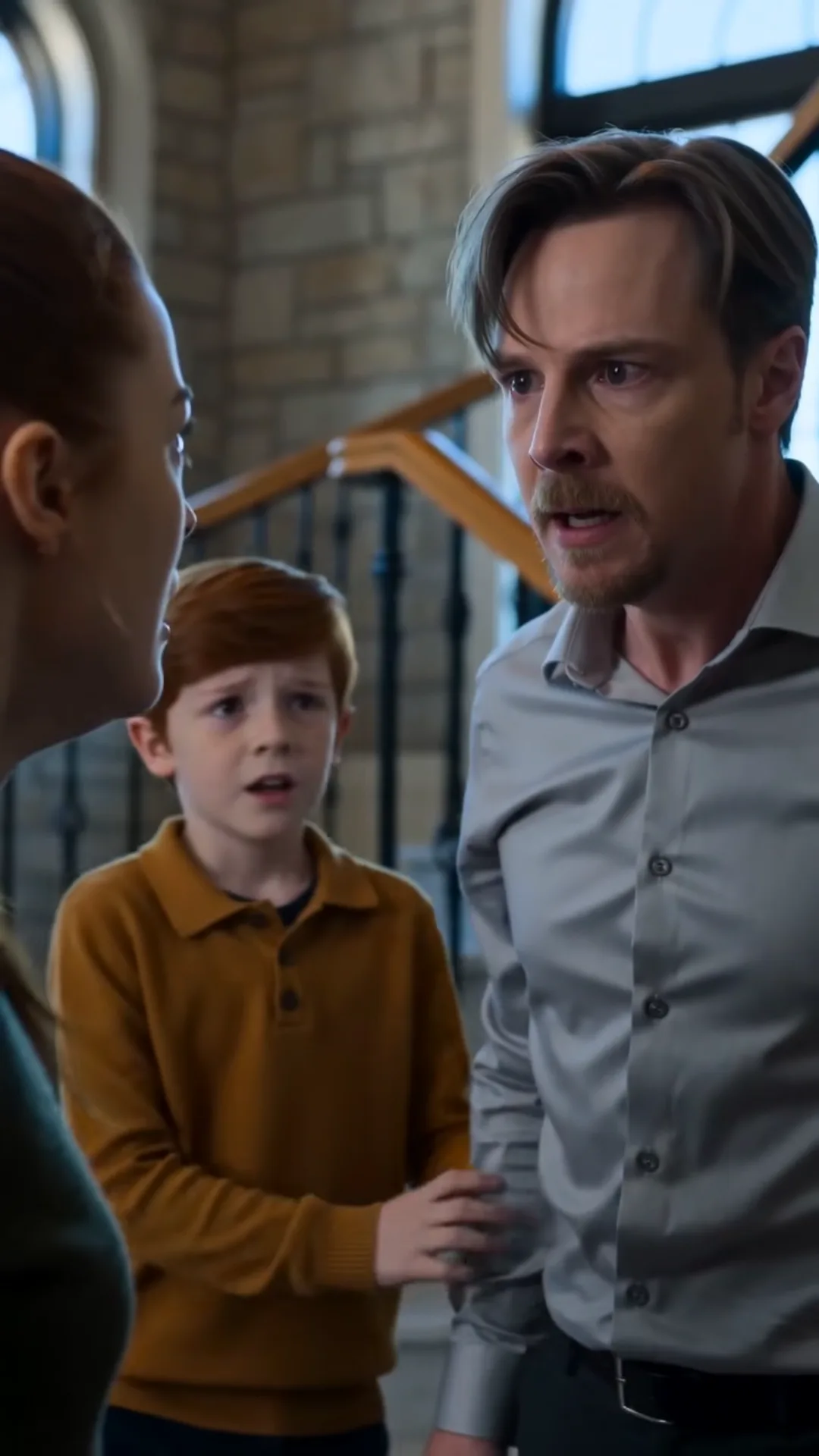
Daniel would remember, for the rest of his life, that the drive home took exactly six minutes, and that he spent all six of them irritated rather than afraid, because irritation was the only emotion his brain had immediately available for the phone call he'd just received — a call from a number he didn't recognize, a stranger's voice from the house's emergency call service telling him his mother had fallen and an ambulance had been dispatched, please come home, please come now.
He had thought, absurdly, of his mother's shoes. She wore the wrong shoes on stairs, always had, ever since her hip surgery three years ago, small heeled things that photographed well and gripped nothing.
He was thinking about shoes when he pulled into the driveway and saw the ambulance already there, lights turning silent and red-blue-red-blue against the white stone of the house, and the shoe-thought evaporated so completely and so fast that he would later be unable to remember, under questioning, what exactly had been in his mind in the three seconds between parking the car and running through his own front door.
The front hall, when he reached it, looked like a stage set from a film about someone else's tragedy — too bright, too clean, the marble gleaming under the arched window's light in a way that struck him, even in the chaos, as somehow obscene, that a floor could look so beautiful while his mother lay motionless on it.
Two paramedics were already working, one with a hand pressed to Margaret's neck checking for a pulse, the other unfolding a backboard with the brisk, practiced calm of people for whom this was simply Tuesday, or Thursday, or whatever this particular day of the week happened to be.
Elena stood a few feet back, one hand pressed to her mouth, tears actually running down her face now — real tears, Daniel would later be forced to admit, because Elena had never needed to fake tears; she simply needed a reason to produce real ones, and the reason she'd found, in the ninety seconds since Justin's flat accusation, was terror. Not terror for Margaret. Terror for herself, at what her stepson had just said and what he might say again, louder, to someone who mattered.
"Daniel—" she started, moving toward him.
He didn't look at her. He dropped to his knees beside the paramedic working on his mother.
"Is she—"
"Pulse is there, sir, weak but there. We need to get her to the hospital now, you can ride with us or follow, but we need to move."
"I'm coming with her."
"Then you need to move back, sir, let us work."
Daniel scrambled back, and it was only then, in the strange suspended half-second while the paramedics lifted his mother's small body onto the backboard with a gentleness that made his chest hurt, that he noticed his son.
Justin was standing at the base of the stairs, exactly where he had been standing for the last four minutes, controller still in one hand, forgotten, his face doing something Daniel had never seen it do before — not the wide-eyed shock he'd expect from a child witnessing an accident, but something tighter, more controlled, a kind of grim, focused waiting, the expression of a boy who has decided exactly what he is going to say and is holding it, carefully, until the right person is finally close enough to hear it.
"Buddy," Daniel said, reaching for him, "hey, it's okay, they're going to help Nana Margaux, she's going to—"
"Dad." Justin's voice cut through his father's reassurance with a clarity that stopped Daniel mid-sentence. "She pushed Grandma."
The word came out wrong — Grandpa, he'd meant to say something else entirely, some strange slip of the tongue that would confuse the responding officers for exactly as long as it took Justin to correct himself, a small human error in an otherwise devastatingly precise accusation, the kind of mistake only a genuinely traumatized nine-year-old, and not a coached one, would make.
"What?" Daniel's brain, still catching up, still three sentences behind the moment, produced only confusion. "What did you say?"
"Elena pushed her," Justin said, correcting himself, his eyes never leaving his stepmother's face across the hall. "I saw it. She pushed Grandma down the stairs."
The paramedics, mid-lift, exchanged a single fast glance — the professional flicker of people trained to notice when a scene of the day has just become something else entirely, an incident with dimensions well beyond a medical emergency — and one of them, without breaking stride, reached for the radio clipped to her shoulder.
"He's confused," Elena said, and her voice, which a moment ago had been steady with rehearsed grief, now cracked audibly, genuinely, the sound of a person watching a floor open beneath her feet in real time. "Daniel, he's confused, he must have seen me trying to catch her, I was trying to catch her—"
"That's not what I saw," Justin said.
"Justin, honey, it happened so fast, it's normal to—"
"I saw it," Justin said again, louder now, his composure finally, understandably, beginning to crack in the other direction, nine years old and suddenly the only person in a room full of adults insisting on the plain, unbearable truth. "I saw you put your hand on her shoulder and I saw you push. I was standing right there. I saw it."
Daniel stood frozen between his mother, being wheeled now toward the door on a gurney, blood dried along one side of her silver hair, and his son, standing rigid and furious at the bottom of the stairs, and his wife, backed against the wall with both hands pressed to her mouth now, and for one terrible, suspended moment he simply could not make his body choose a direction.
"El," he said, and his own voice sounded strange to him, thin, far away. "Tell me he's wrong."
"He's wrong, Daniel, of course he's wrong, why would I ever—"
"She slipped!" Elena's voice rose now, cracking fully, real panic finally breaking through the careful architecture of the last four minutes. "The steps were wet, I told the housekeeper I'd redo the wax, maybe I did it wrong, maybe it made them slicker, but I did not touch her, Daniel, I swear to God, I did not touch her—"
It was the wrong thing to say, and some animal part of her recognized it half a second too late — the mention of the wax, unprompted, unnecessary, a detail nobody had asked about, hanging in the air of the front hall like a confession dressed up as an alibi.
Daniel's face changed.
It was not dramatic. It was small, almost imperceptible to anyone who hadn't spent eleven years learning every micro-expression his wife's face was capable of producing — a narrowing at the corners of his eyes, a stillness in his jaw that Daniel himself would not have been able to name in the moment but that Elena recognized instantly, with the sick lurch of someone watching the last door in a burning building swing shut.
"You waxed the stairs," he said slowly.
"Daniel, that's not what I—"
"You told me last week the housekeeper does the stairs. You specifically said you don't touch that stuff, it's not your job, remember? You said it at dinner. I remember you saying it."
"I was trying to help, I read an article—"
"El."
Just her name, said flat, said the way you say a word you're testing for weight, for truth, for the specific gravity of a lie versus the specific gravity of a fact, and Elena, watching her husband's face rearrange itself in real time from grief into something far colder, understood with total clarity that whatever version of her marriage had existed twenty minutes ago no longer did, and that nothing she said in the next several minutes, however carefully chosen, was going to bring it back.
One of the paramedics, pausing at the threshold with the gurney, looked back into the hall.
"Sir, we need to go, now, if you're riding with us."
Daniel did not move immediately.
He looked at his mother, pale and motionless on the gurney, blood in her silver hair, pearls scattered somewhere on the marble behind him.
He looked at his son, standing rigid at the base of the stairs, controller finally, unconsciously, dropped from his hand, clattering unnoticed against the floor.
And he looked, last and longest, at his wife — the woman he had married fourteen months after a charity gala where she'd worn a coat-check apron and made him laugh harder than he had in years, the woman who had, for a while, made a house that had felt hollow since Corinne died feel occupied again — and something in his chest, watching her face cycle rapidly through fear and denial and something colder underneath both of those, finally, completely, broke.
"Go," he told the paramedics. "I'm coming."
And then, to Elena, in a voice she would hear in her sleep for the rest of her life, flat and quiet and entirely without the warmth that had characterized every word he'd ever said to her before this one:
May you like



"Don't leave this house."
---







