Chapter 8 - The Slap
She did not leave the house.
She meant to, for one wild, animal minute after the ambulance pulled away, its siren rising and falling as it turned onto the main road — she stood in the front hall with her keys already in her hand, some primitive part of her brain screaming run, get in the car, drive, figure out the rest later — but the keys stayed in her hand and her feet stayed on the marble, because some other, colder part of her, the same part that had watched a stranger's houses her whole childhood and learned exactly how far a lie could carry a person before it collapsed, understood that running was the one thing that would turn suspicion into certainty.
She had, she told herself, one chance left. A very small one. But a chance.
If she stayed. If she was calm, contrite, confused, a grieving daughter-in-law wrongly accused by a traumatized child who'd misread a chaotic five seconds. If she held the line she'd already, disastrously, started to hold.
She sat down at the kitchen island — the same seat where, days ago, she'd checked a banking app that hadn't yet changed — and waited, hands folded in front of her, for her husband to come home.
Justin sat across the room on the living room couch, a neighbor Daniel had called on his way to the hospital — an older woman named Grace who lived two houses down and had known the family for a decade — sitting beside him with an arm around his shoulders, murmuring things meant to be comforting that Justin did not appear to be listening to at all.
He was watching Elena.
He had not stopped watching her since the ambulance left, his eyes tracking her the way you track something you've identified, correctly, as dangerous — not with fear exactly, because Justin, in the particular alchemy of shock and clarity that trauma sometimes produces in children, did not seem afraid of Elena so much as finished with her, a boy who had already, mentally, filed her under a category from which there was no appeal.
"You don't have to look at me like that," Elena said finally, unable to bear the silence, unable to bear his eyes.
Justin didn't answer.
"I know what you think you saw," she tried again, and heard, even as she said it, how thin it sounded, how much like exactly the kind of thing a guilty person says. "But it happened so fast, Justin. Things look different when they happen fast."
"I know what I saw," Justin said. It was the same flat, unshakeable tone he'd used on the stairs, and something about the repetition of it — the fact that four minutes and a hospital-bound ambulance ride hadn't changed his account by a single word — was, to anyone listening, far more damning than any amount of shouting could have been.
Grace, the neighbor, looked between the two of them with the careful, uncomfortable neutrality of someone who has just realized she's stumbled into the middle of something far larger than a fall down the stairs, and said nothing at all.
---
Daniel came home two hours later.
His mother was stable — a fractured wrist, three cracked ribs, a concussion that the doctors wanted to monitor overnight, a laceration on her scalp that had needed nine stitches and would leave a scar hidden, mercifully, under her hair. She had not regained full consciousness by the time he left, but a doctor had told him, with the careful optimism doctors reserve for situations that could still go either way, that her vitals were strong for a woman her age, that people did survive falls like this, that the next twenty-four hours would tell them more.
He had not told his mother's care team, in those two hours, anything about what his son had said in the front hall.
He had sat in a fluorescent-lit hospital corridor and replayed it instead, over and over, the wax detail surfacing again and again like something poisonous washing up on a shore — I told the housekeeper I'd redo the wax — a detail that made no sense as an accident and perfect, horrifying sense as a plan.
By the time he pulled back into his own driveway, something in him had gone past anger into a kind of controlled, terrible calm, the calm of a man who has already, somewhere in a hospital corridor, made a decision he isn't yet willing to say out loud.
He found Elena still at the kitchen island, exactly where she'd been sitting for the last two hours, Grace gone now, Justin upstairs in his room at the neighbor's insistence that he try to rest.
"How is she?" Elena asked, standing as he entered.
"Alive," Daniel said. "No thanks to you."
"Daniel—"
"Don't." He held up a hand, and something in the gesture — controlled, precise, entirely unlike the panicked, grieving husband who'd left two hours ago — made Elena take an involuntary step back. "I talked to Ellery."
The name landed in the kitchen like something dropped from a height.
"You called Ellery? Daniel, my God, your mother's in the hospital and you're calling her lawyer—"
"I called him because I wanted to know what changed yesterday. What you were so worried about that you needed to lie to my mother's face about hearing from him. And you know what he told me?" Daniel's voice, still quiet, had acquired an edge Elena had never heard from him before, not once, in eleven years. "The trust was already signed. Two days ago. Filed Monday. There was nothing left to stop, El. Nothing. You did this for a document that was already done."
Elena's face, for the first time all day, showed something that was not performance at all — a genuine, naked horror, the particular horror of a person realizing, in real time, that the catastrophe they caused had accomplished nothing except the catastrophe itself.
"That's not—" she started, and then stopped, because there was, finally, nothing true or useful left to say.
"Justin said you pushed her," Daniel said. "You said the stairs were wet because you waxed them. You knew about a signature that didn't exist to get her to stop on the stairs. Every single piece of this fits together, El, and none of it fits together by accident."
"I didn't mean—" Her voice broke fully now, and whatever was left of the composed, careful woman who had rehearsed her grief in a mirror three days earlier collapsed entirely, leaving behind something raw and frightened and, for the first time since the wedding, almost recognizably human. "I panicked. I wasn't thinking. I never wanted her to actually get hurt, I just wanted—"
"You wanted what."
"I wanted time," Elena said, and it came out as something close to a sob. "I just wanted more time before it was final. I didn't think it through, Daniel, I swear to you, I didn't plan for her to fall like that, I didn't plan for any of it, I just—"
"You just pushed my mother down the stairs," Daniel said, "and let our son watch you do it."
Something in Elena's face, hearing it said that plainly, that simply, finally gave way entirely.
"I'm sorry," she said. "God, Daniel, I'm so sorry—"
He crossed the kitchen faster than she expected, and for one wild half-second she thought — hoped, some desperate animal part of her hoped — that he was moving toward her to hold her, the way he had a thousand times before in eleven years of marriage, that some final reserve of love might override everything he now knew.
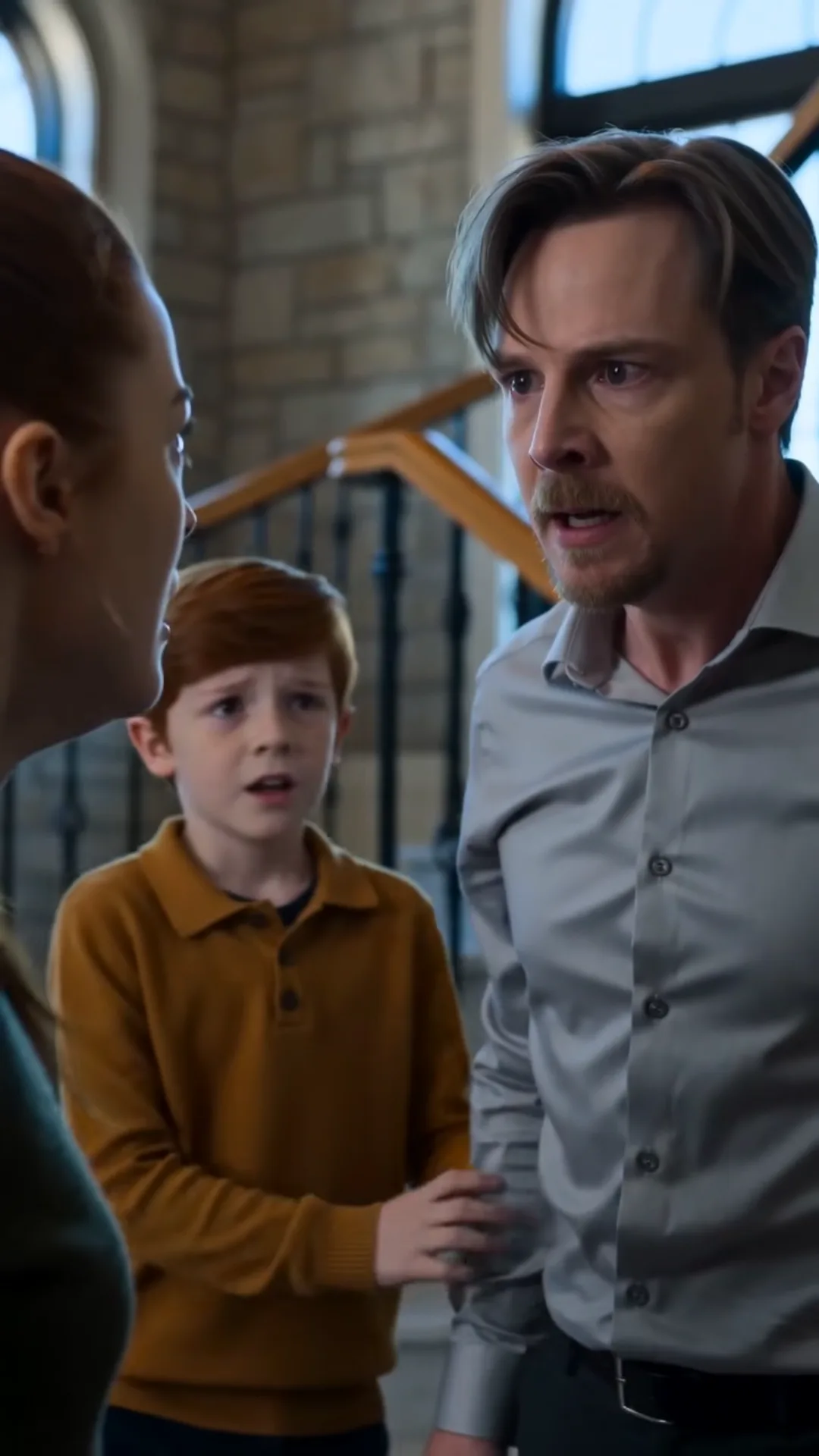
Instead his hand caught her arm, not gently, and pulled her toward the front hall, toward the stairs, his voice low and furious in a way she had never once heard from him.
"Say it to her," he said. "You're going to say it to her face when she wakes up. Every word."
"Daniel, let go, you're hurting—"
"You think this hurts?" He stopped at the base of the stairs, still gripping her arm, and for a moment it looked, to the small figure who had appeared silently at the top of them — Justin, drawn from his room by the raised voices, standing exactly where he had stood four hours earlier, watching exactly the same two adults from exactly the same angle — like something might happen that could not be undone.
Then Daniel's other hand moved, fast, before either of them fully registered it was happening, and the sound of his palm against her cheek cracked through the front hall with a violence that seemed, in that bright, marble-floored space, entirely too large for the two people producing it.
Elena's head snapped sideways. Her hand flew to her cheek. For a moment neither of them moved at all, both of them equally shocked by what had just happened, Daniel's own hand still raised, trembling now, a man who had never in his life struck anyone and would spend the rest of his life unable to fully explain why he had, on this particular afternoon, finally done it.
"He's lying," Elena said, but her voice had lost all its conviction now, thin and desperate, grasping at a defense that had already, hours ago, stopped holding any weight at all. "Justin—"
She looked up, and saw him there, at the top of the stairs, small and still and watching, exactly as he had watched the entire thing unfold from the very beginning, and something in his face — not triumph, not even satisfaction, just a flat, exhausted certainty — told her, more clearly than any words could have, that whatever she said next would change nothing at all.
"That's not what happened," Daniel said, lowering his hand, his voice shaking now with something that had moved past fury into a kind of devastated disbelief. "You pushed my mother."
And Justin, from the top of the stairs, in the same quiet, unshakeable voice he'd used from the very first moment, said the thing that would end, finally and completely, whatever remained of the life the three of them had built together in that beautiful, treacherous house.
May you like



"Dad," he said. "That's not the worst thing she did."
---







