Chapter 4 - The Basement Hallway
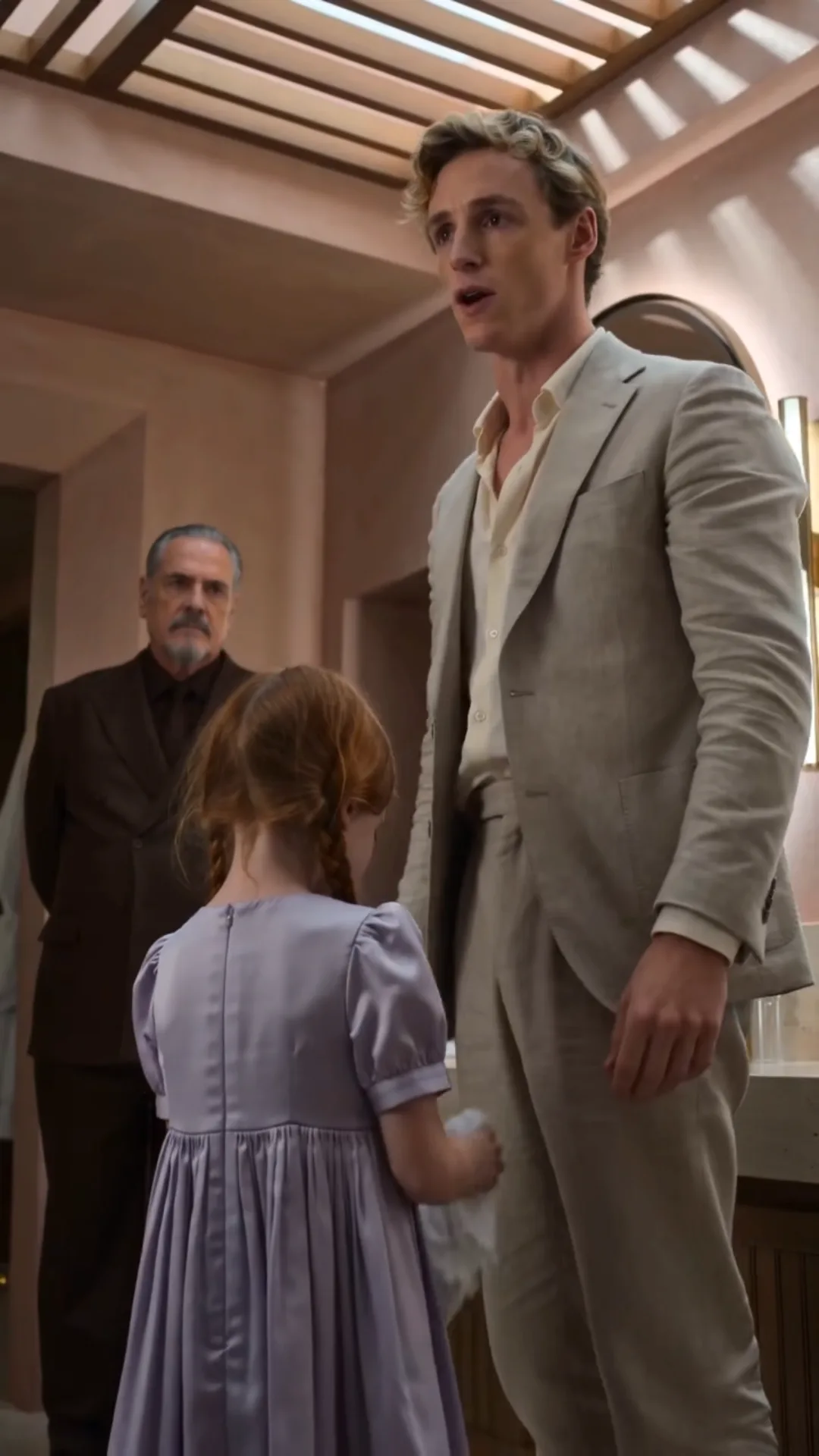
The hallway that led to the staff quarters did not look like it belonged to the same house.
Upstairs, everything was marble and gold and glass, light bouncing off every surface like the building itself was proud of what it had swallowed to become beautiful.
Down here, the walls were plain white, scuffed at knee height where carts had been pushed too many times through too narrow a space. The light came from bare bulbs in wire cages, buzzing faintly, the kind of sound you only notice once everything else has gone quiet.
Rafael's shoes made no sound on the tile. Luna's little sandals slapped softly beside him, uneven, half-running to keep up with his longer stride, though he had slowed himself without seeming to notice he was doing it.
"¿Está muy lejos?" she asked. Is it far.
"No," he said. "Ya casi."
Almost there.
He knew this hallway better than he had ever let anyone upstairs believe. He knew which door stuck in humid weather. He knew the exact number of steps between the laundry room and the little kitchenette where the staff ate standing up, because sitting down was a luxury reserved for people whose names were on deeds.
He knew it because once, a long time ago, he used to walk this hallway on purpose. Not out of duty. Out of wanting to be somewhere that his mother's voice couldn't follow him so easily.
They turned a corner, and Luna's hand tightened in his.
Ahead, through a half-open door, a woman was on her knees scrubbing a floor that already gleamed, moving with the exact same violent, desperate rhythm Luna had used upstairs on a countertop that hadn't needed her at all.
Rafael stopped walking.
For a second, all he could do was watch — a mother and a daughter, in two different rooms of the same enormous house, teaching their bodies the same frantic apology to floors and stone that had never once asked anything of them.
"¿Mamá?"
The woman's head snapped up.
Camila.
Rafael hadn't said her name out loud in eleven years, though it had lived somewhere behind his ribs the entire time, folded small, taken out and looked at only in private, only late at night, only when the house was quiet enough that no one could see his face do the thing it was doing now.
She rose to her feet too fast, swaying slightly, one hand braced against the wall.
Her eyes went from her daughter's tear-streaked face to the man standing beside her, and something happened in her expression that took years off her and added them right back on in the same breath — recognition, disbelief, and underneath both of those, a fear so old it had its own permanent address in her body.
"Rafael," she said. Barely a whisper.
"Camila."
The name between them held eleven years of silence, and neither of them seemed to know what to do with all that weight now that it had finally been given a voice again.
Luna looked between them, confused by the sudden stillness, by the way the air itself seemed to have changed temperature.
"¿Se conocen?" she asked. You two know each other?
Neither adult answered right away.
Camila's hand came up, instinctively, toward her daughter, pulling her gently against her hip, a mother's reflex older than thought — protect first, explain never, if you can help it.
"Luna," Camila said carefully, not taking her eyes off Rafael, "ve a la cocina un momento. Toma algo de tomar."
Go to the kitchen for a moment. Get something to drink.
"Pero—"
"Por favor, mi amor."
Luna hesitated, glancing up at Rafael as if seeking permission, or reassurance, or both.
He crouched one more time — the third time that night he had lowered himself to her height, and each time it seemed to cost him something different — and touched her shoulder lightly.
"Ve," he said. Go. "Voy a estar aquí."
I'll be here.
She believed him. Children believe promises the way adults believe gravity — not because they've tested it, but because the alternative is too frightening to consider.
She walked toward the little kitchenette at the end of the hall, glancing back twice before disappearing through the doorway.
The moment she was gone, the hallway seemed to exhale.
Camila's composed mask, held together by years of practice, began to come apart at its seams.
"¿Por qué estás aquí?" she asked. Her voice shook. Why are you here.
"Vivo aquí, Camila. Siempre he vivido aquí."
I live here. I've always lived here.
"No en esta ala," she said, gesturing at the plain white walls around them, the buzzing bulbs, the world beneath the world upstairs. "Nunca vienes aquí."
You never come here.
"Vine porque encontré a tu hija llorando en un baño," he said, "tratando de limpiar algo que no estaba sucio, porque alguien le dijo que si no lo hacía, ustedes dos iban a terminar en la calle."
I found your daughter crying in a bathroom, trying to clean something that wasn't dirty, because someone told her that if she didn't, the two of you would end up on the street.
Camila's face crumpled.
Not into tears — into something harder, angrier, the expression of a woman who has spent years absorbing blows meant for someone else and has finally run out of places to put them.
"¿Fue mi madre?" Rafael asked quietly. Was it my mother?
Camila didn't answer. She didn't have to.
"Camila." His voice cracked slightly on her name. "¿Por qué no me dijiste que habías vuelto?"
Why didn't you tell me you'd come back.
"¿Para qué?" she said, and now the anger broke through fully, eleven years of it arriving all at once, unstoppable. "¿Para que tu madre me despidiera el mismo día? ¿Para que me sacara de aquí antes de que pudiera juntar suficiente dinero para un lugar propio?"
For what? So your mother could fire me the same day? So she could throw me out before I'd saved enough to get a place of our own?
"No sabía que estabas de vuelta trabajando aquí," Rafael said. "Si lo hubiera sabido—"
"¿Qué?" Camila cut him off, stepping closer, years of restrained hurt suddenly finding a target. "¿Qué habrías hecho, Rafael? ¿Le habrías dicho a tu familia la verdad? ¿Después de once años?"
What would you have done, Rafael? Would you have told your family the truth? After eleven years?
The hallway went silent except for the buzzing of the bulb overhead.
Rafael's throat worked, but no words came for a moment, because the question wasn't really a question. It was an accusation, wrapped carefully, deployed with precision, aimed exactly where it would hurt most.
"Yo era joven," he said finally, quietly. "Tenía diecinueve años, Camila. Mi padre me habría desheredado. Mi madre te habría destruido. Lo sabías. Los dos lo sabíamos."
I was young. I was nineteen. My father would have disinherited me. My mother would have destroyed you. You knew that. We both knew that.
"Así que me fui," Camila said. "Me fui embarazada, sola, sin nada, porque tú tenías demasiado miedo de decir la verdad."
So I left. Pregnant, alone, with nothing, because you were too scared to tell the truth.
The word landed between them like something dropped from a great height.
Embarazada.
Pregnant.
Rafael's face went through several things at once — confusion, disbelief, the slow arrival of an understanding too large to hold all at once.
"¿Qué?" he whispered.
Camila's hand rose to her mouth.
She had said it. After eleven years of silence, of distance, of building an entire life around a secret she had sworn to keep buried, the truth had slipped out in a hallway lit by buzzing bulbs, in front of the one person she had spent over a decade making sure never found out.
Down the hall, in the small kitchenette, a little girl with damp brown hair sat on a stool swinging her feet, sipping water from a plastic cup, unaware that the entire architecture of her life had just shifted on its foundation, two rooms away, in the space of a single whispered word.
Rafael's eyes moved slowly, involuntarily, toward the kitchenette door.
"Camila," he said, his voice barely holding together. "¿Luna es—?"
He couldn't finish the sentence.
May you like



Camila's silence finished it for him.
---







