Chapter 1 - The Phone Call After Midnight
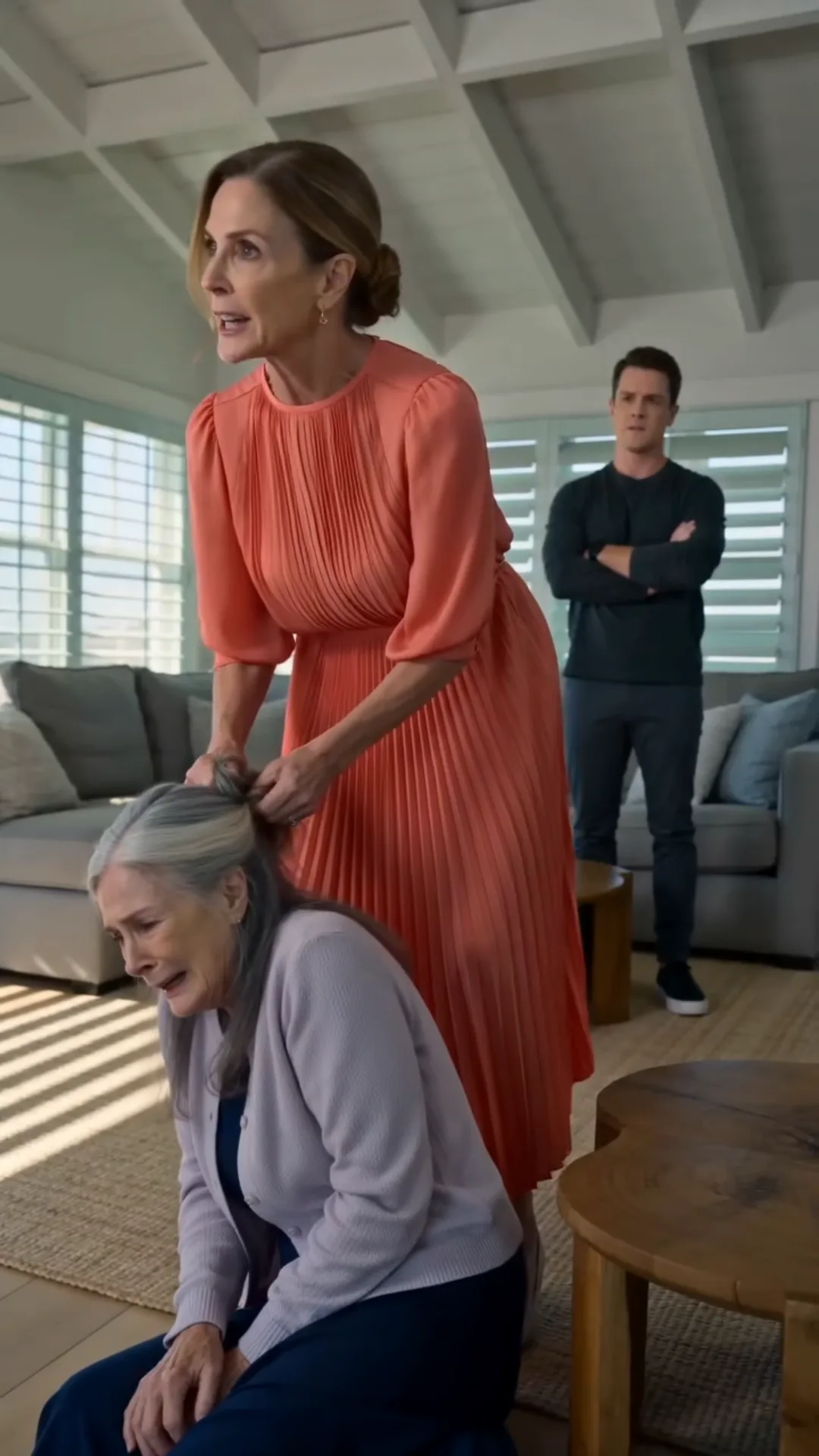
The phone rang at 12:41 a.m.
Sarah knew before she looked at the screen.
Nobody calls at 12:41 unless something is already broken.
"Mommy?"
Lily's voice was small. Smaller than seven years old should sound.
"Baby, why are you whispering?"
"I'm under the bed."
Sarah sat up so fast the blanket slid to the floor like something shedding skin.
"Why are you under the bed?"
A pause. The kind of pause a child fills with breathing instead of words.
"Grandma Eleanor's crying again. Aunt Diane said if I come out she'll take my night-light."
Sarah's hand found the lamp switch without her eyes.
Click.
The room went yellow. Too yellow. Like the light in that house.
"Is Grandma hurt?"
"She has a red mark. On her arm. Like a bracelet but not a bracelet."
Sarah's throat did something complicated.
"Don't come out yet. Stay on the phone with me."
"Okay."
"Count something. Count the dust bunnies under the bed."
"There's four. One looks like a rabbit. One looks like Uncle Jimmy's hair."
A laugh cracked out of Sarah before she could stop it. It surprised her — laughter, in a moment like this.
That was the thing about Lily. She said things sideways, and sideways things landed straighter than anything aimed.
---
Three years ago, Sarah had packed one suitcase and left Birchwood Lane before sunrise.
She hadn't said goodbye to her brother.
She'd said goodbye to the house instead — stood in the driveway, looked at the porch light, and said, I'm sorry I couldn't fix it, to nobody, to the mailbox, to herself.
Jimmy had married Diane eight months before that.
Diane, who reorganized the kitchen the week she moved in.
Diane, who called it "restructuring the household," the way people talk about companies instead of families.
Diane, who smiled with her mouth and audited with her eyes.
Sarah remembered the specific weight of Diane's attention. How it landed on a person like a hand on the back of the neck — not a slap, not yet, just pressure. Just enough to make you walk the way she wanted.
Eleanor had noticed it too. Eleanor noticed everything; she just believed, the way her generation was taught to believe, that dignity meant not saying so out loud.
"She's just particular," Eleanor had said once, defending Diane the way mothers defend the weather. "You'll see. Give her time."
Sarah had given her three years of not looking.
That had been the mistake.
---
"Lily. Is Uncle Jimmy there?"
"He's on the couch. He's not doing anything."
Not doing anything.
Sarah had heard that phrase about Jimmy her entire adult life. He's not doing anything. He never does anything. That was supposed to mean he was harmless.
She was starting to understand that not doing anything, in that house, was its own kind of doing.
"Okay, baby. I need you to do something very important. Can you be my secret helper?"
"Like a spy?"
"Exactly like a spy."
A rustle. The sound of small knees shifting on carpet.
"Spies write things down. Can you remember what you saw tonight, and tell me again in the morning, when it's light?"
"I don't need morning. I remember now. Grandma's cardigan has a rip at the shoulder. From Aunt Diane's hand. And Grandma said 'please' four times. I counted."
Four.
Sarah closed her eyes.
Seven years old, and already counting the pleases of a grown woman being hurt in her own living room.
"You did so good, Lily. You did such a good job."
"Am I in trouble for hiding?"
"No. Baby, no. Hiding was smart. Hiding was the smartest thing."
"Diane says hiding means I'm being difficult."
There it was. The sentence that told Sarah everything about the last three years in one blow.
Difficult.
The word Diane used for anyone who didn't disappear quietly enough to suit her.
---
Sarah didn't sleep that night.
She sat at her kitchen table with a legal pad she hadn't touched since she left her old job at the county family services office — the job where she used to write reports that decided whether children got to stay somewhere, or didn't.
She wrote the date at the top.
She wrote: 12:41 a.m. Phone call. L. reports visible mark on E.'s arm. L. reports E. said "please" x4. L. reports J. present, non-intervening.
Old habits. Old language. The clinical distance she used to hide behind so the reports didn't shake in her hands.
It didn't work this time.
Her hands shook anyway.
She looked at the paper for a long time.
Then, underneath the note, she wrote something that wasn't clinical at all.
I'm coming back.
She underlined it twice.
Outside, the neighborhood was quiet, the kind of 2 a.m. quiet that pretends nothing bad happens anywhere while it's listening. Sarah looked out at the dark street and thought about Birchwood Lane four hours away — the beige sofa, the wooden coffee table, the floor lamp that made everything look warm even when nothing warm was happening.
She thought about her mother's hands. How they used to smell like rosewater and flour. How they used to braid Sarah's hair on Sunday mornings, humming something off-key.
Now those hands had a mark on them like a bracelet that wasn't a bracelet.
Sarah picked up the phone again and texted her brother.
Jimmy. Call me. It's important.
No reply.
She hadn't expected one. Jimmy had gotten good at not answering things. That, too, was a kind of doing.
She set the phone face-up on the table, where she could watch it not ring, and began to write down everything she remembered about the last three years — every small warning sign she had left behind unexamined, like a house she'd walked out of without checking whether the stove was off.
By 4 a.m. the legal pad had fourteen pages.
By 5 a.m. she had a plan.
It didn't look like a plan yet. It looked like a list of phone numbers — her old supervisor at family services, a friend from law school who did elder-fraud litigation, the number for Eleanor's bank branch, memorized from childhood errands, still lodged somewhere behind her ribs.
She didn't know yet that one of those numbers would end up mattering more than all the others combined.
She only knew that somewhere, forty miles or four hundred miles or four years away, a little girl was under a bed, counting dust bunnies to keep herself calm, while an old woman upstairs learned to say please in a house that used to be full of rosewater and humming.
Sarah folded the pages in half.
She looked at the sentence she'd underlined twice.
I'm coming back.
Outside, the sky was starting, barely, to lighten at the edges — the color of something that hadn't decided yet whether it would be morning or just a paler kind of dark.
She started packing before the decision had fully finished being a decision.
Some choices work like that. The body moves before the mind agrees to it, because somewhere underneath thought, a much older voice has already said the only sentence that ever mattered.
Not this time.
Not this time, she was not going to look away from what a house could do to the people trapped inside its walls.
May you like



Not this time, she was going to walk back through that door and find out exactly what had happened in the three years since she'd stopped watching.
---