Chapter 1 - The Bag on the Floor
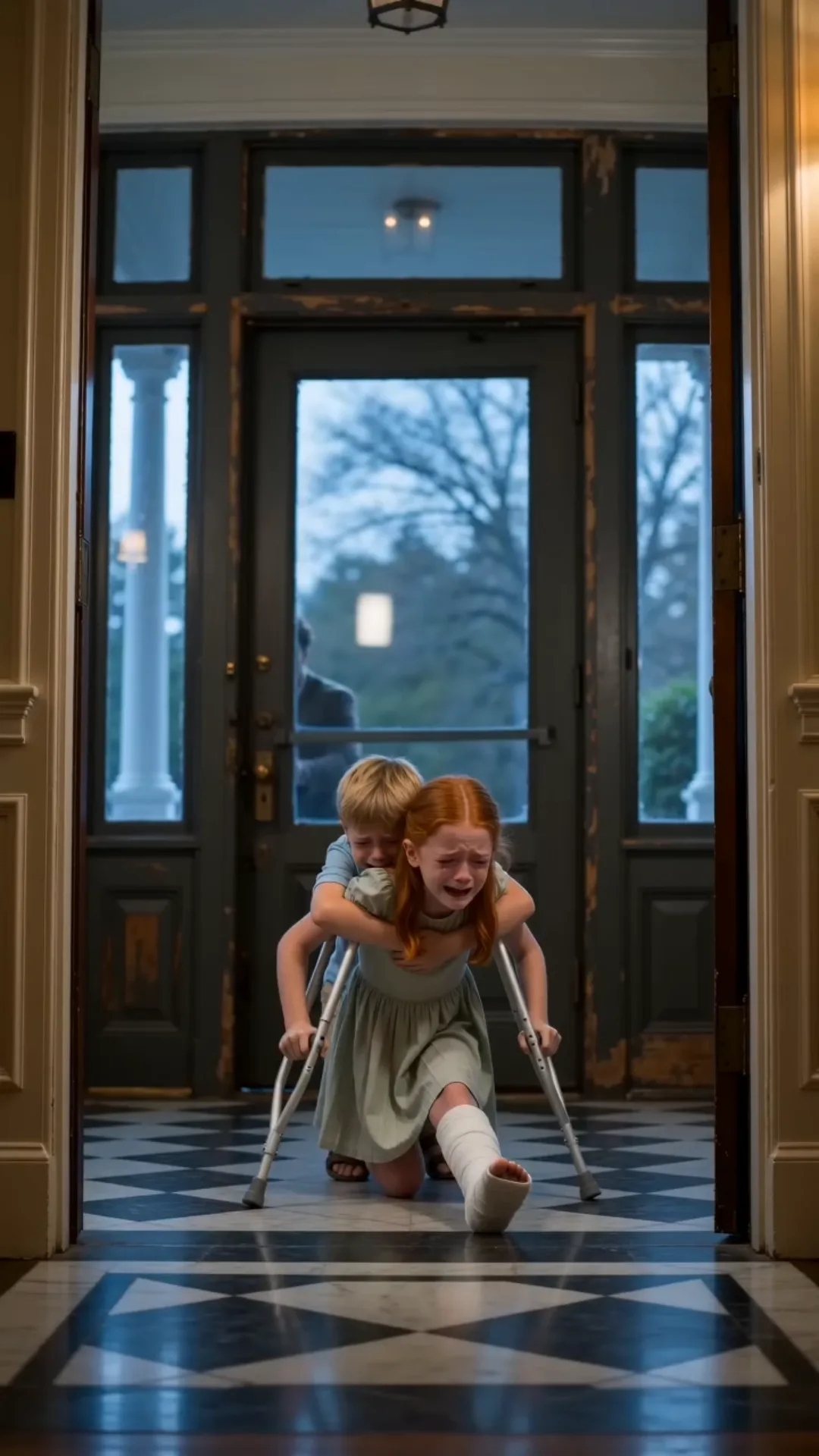
The marble floor holds light like water holds a stone.
It does not let go easily.
Every lamp in the hallway throws itself down onto that white surface and comes back up doubled, tripled, until the whole corridor looks like it is standing in a shallow, glowing river.
A girl is kneeling in the middle of it.
Her hair is the color of dry wheat, pulled half-loose from a braid that someone did for her yesterday, maybe two days ago. Her dress has small flowers printed on it, pale pink and pale yellow, the kind of dress a mother picks out in a boutique and a daughter never gets to choose herself.
Her left leg is wrapped in white plaster from ankle to knee.
Two aluminum crutches lie beside her on the marble, fallen sideways, useless now, because she is not standing. She is on her knees, both of them, the good one and the leg she is not supposed to bend, and she does not seem to notice the second thing at all.
On her back is her brother.
He is small enough that his sandals barely reach past the middle of her spine. He has fists in her hair. He is screaming, the kind of scream that comes from somewhere below language, before words, a sound that exists only to say wrong, wrong, wrong.
She does not scream back.
She breathes.
In, out. In, out. Her arms are locked behind her, elbows aching, holding his knees against her ribs so he does not slide.
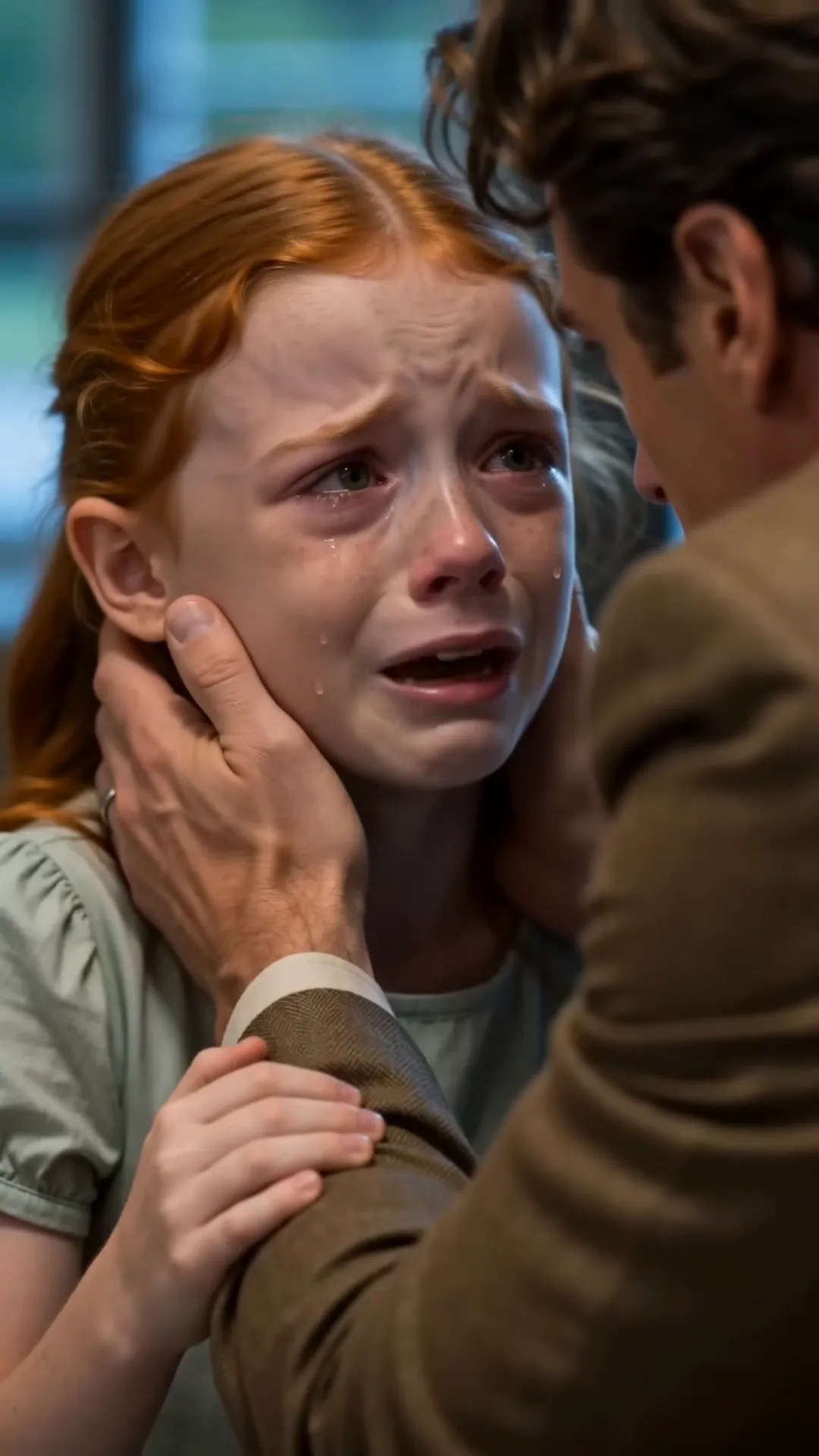
Her face is wet.
Not from crying loudly — there is no sound coming from her mouth at all — but her eyes have been leaking for a while now, silently, the way a cracked glass leaks water without ever actually shattering.
The front door opens.
It is heavy, glass and dark steel, and it swings on a hinge so well-oiled that it makes almost no sound, which is somehow worse, because it means nobody heard him coming, and now he is simply here, all at once, filling the doorway.
A man.
Thirty-something, maybe forty, the kind of handsome that photographs well from every angle, a face built for boardrooms and school pickup lines alike. He is wearing a navy suit with the tie already gone, the top shirt button open like he tore it loose somewhere on the drive home.
He is holding a black leather bag in his right hand.
It has flight tags still clipped to the handle.
He sees the hallway.
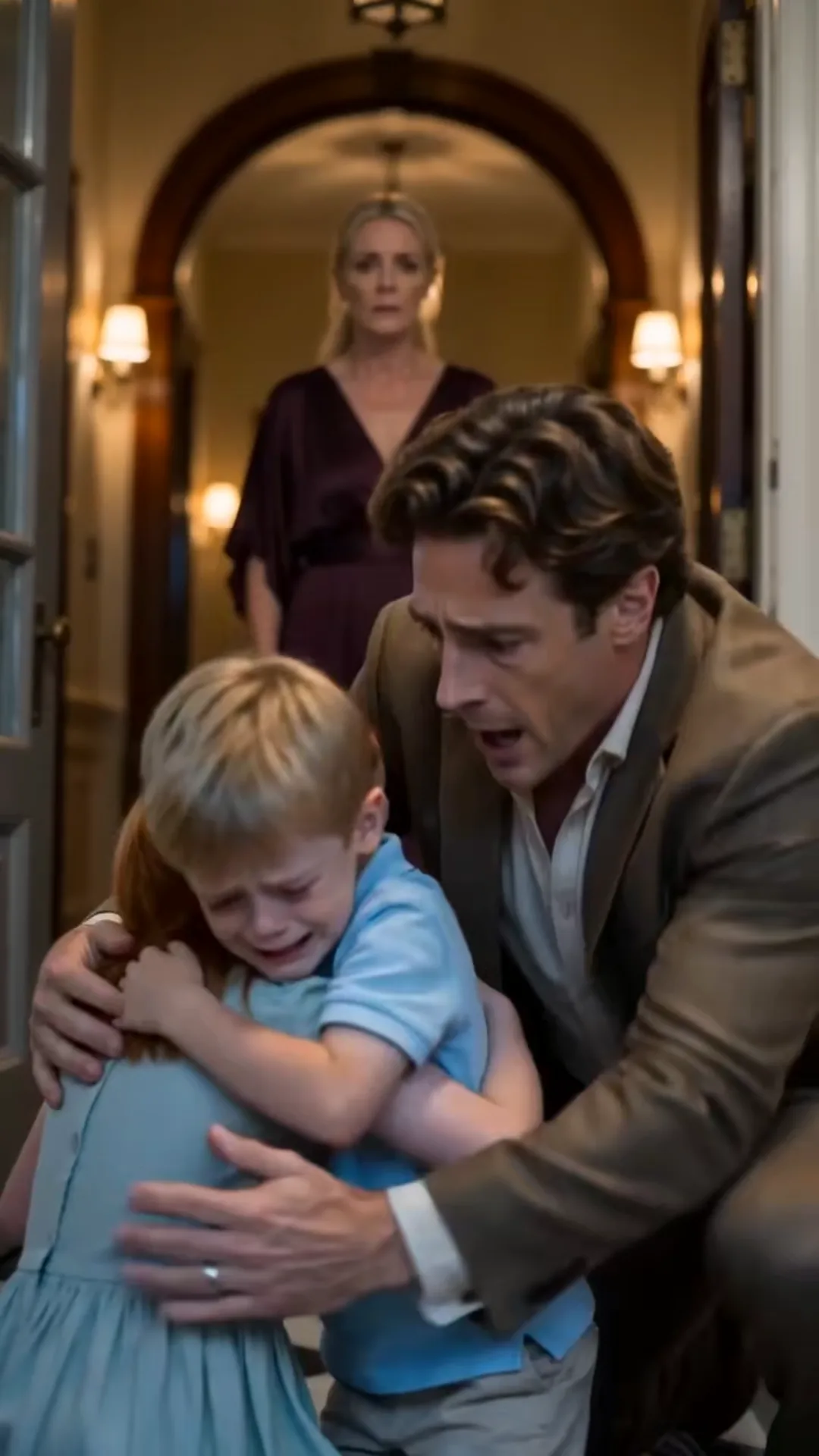
He sees his daughter on the floor, in the cast, on her knees, holding his son.
The bag drops.
It does not slip. It does not tumble from his fingers by accident. It simply falls, straight down, because every muscle in his hand has forgotten, for one full second, what its job is.
It hits the marble with a sound too big for its size — a flat, hard crack that rolls down the hallway and comes back off the glass walls, and for a moment it is the loudest thing in the house, louder even than the toddler's screaming, because it is the sound of a plan ending.
He does not move yet.
His mouth is open.
Behind him, in the doorway, a second shape appears — slower, quieter, a woman in a dress the color of drying blood, dark red silk that moves like it is thinking about whether it wants to enter the room at all.
She stops just past the threshold.
She does not kneel. She does not reach for either child. She stands with her hands loose at her sides, and her face has the stillness of a photograph of a face, something that used to move and has decided, for now, not to.
Nobody looks at her yet.
All the light in the hallway, all the reflected fire of every lamp doubled on white stone, seems to be pouring toward the two children on the floor and the man frozen four steps away from them.
His voice, when it finally comes, cracks down the middle like the light on the marble.
"Emily!"
It is not a greeting. It is not even really a question. It is the sound of a man throwing a rope across a gap he has only just noticed is there — a gap that, judging by the sound of his own voice, he suspects has been there for a very long time, and he is only now the first to look down.
The girl on the floor lifts her head.
She does not answer with words. Not yet. She simply looks at him, and something in her small, wet face rearranges itself — not relief exactly, not yet, but the shape relief will eventually take, once it has room to arrive.
Her brother keeps screaming into her hair.
Her hands stay locked around his knees.
She has been doing this — this exact thing, this holding, this bracing — for longer than anyone standing in that hallway yet understands.
The black bag lies open now, its clasp sprung from the impact, papers sliding half out onto the white stone. Nobody looks at the papers. Not yet. There will be time, later, terrible and necessary time, for someone to look at what is inside that bag and understand what it means that he was carrying it home today of all days.
For now there is only the marble, and the light doubled in it, and a girl on her knees holding the only weight she has ever been asked to carry alone.
The woman in the red dress finally moves.
One step. Only one.
It brings her no closer to either child. It only brings her fully into the doorway's light, so that for the first time her face is visible without a shadow crossing it — and on that face is an expression that does not belong to a woman simply startled by noise.
It belongs to someone who has been expecting, for a long time, that a day like this one would eventually come.
The man is already moving.
His polished shoes slide slightly on the wet-looking stone as he crosses the last four steps in two long strides, suit jacket flaring open, and the black bag is forgotten completely behind him, spilled and open and full of things that will matter enormously in nine days, in nine minutes, but do not matter at all right now.
Right now there is only his daughter's face.
Right now there is only the sound his son is making, and the sound his daughter is not.
He drops to both knees in front of her, and the marble is cold enough that he feels it instantly through the fabric of his trousers, a small shock of temperature that will stay with him, oddly, for years — the exact coldness of the floor on the day he finally came home in time.
Almost in time.
Not quite in time.
May you like



But close enough, this once, to catch what was falling.
---