Chapter 9 - Daddy, Please Don't Leave
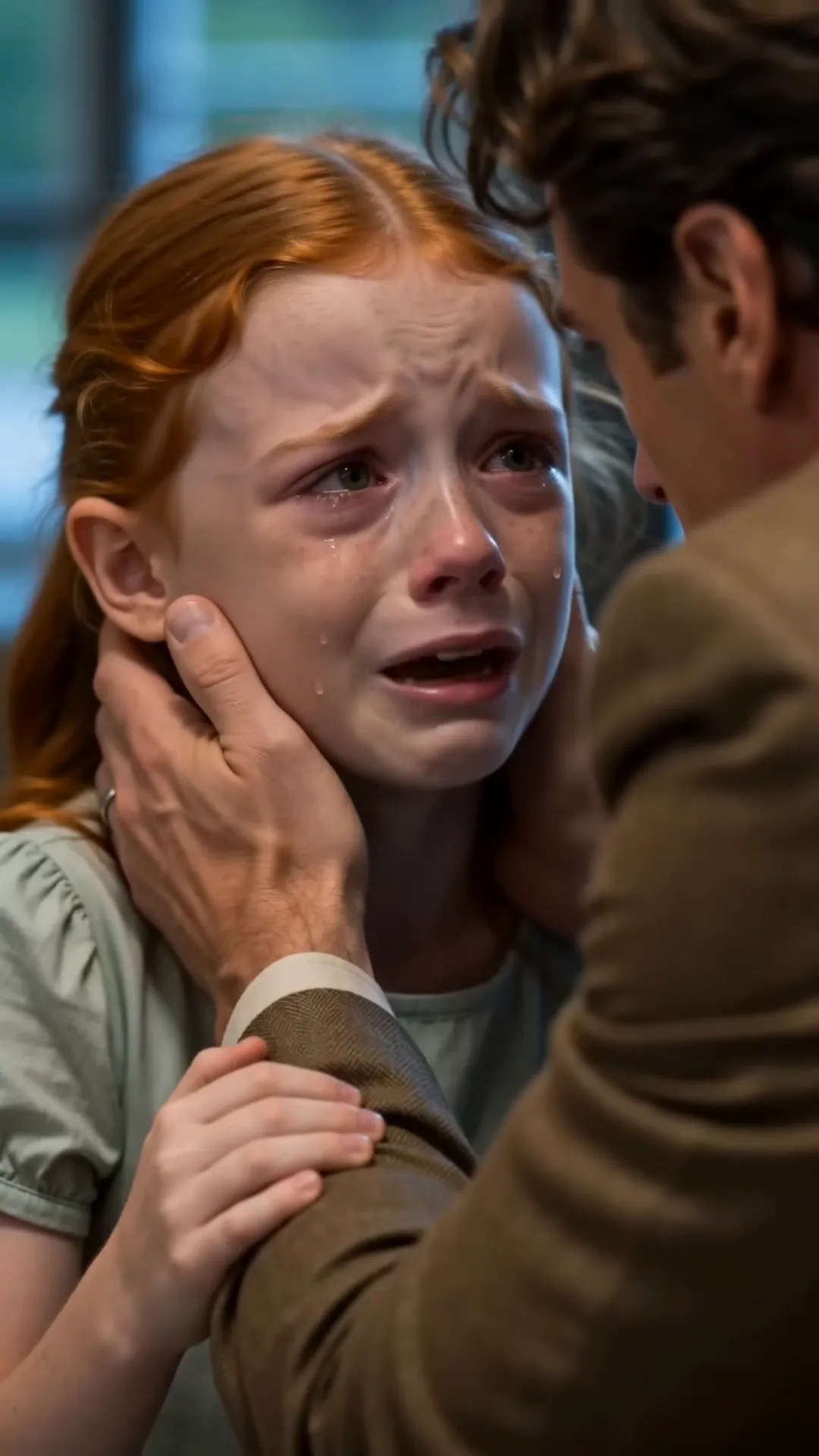
Daniel finally turned his head.
His wife had not moved from the spot by the doorway. The dark red dress caught the hallway's doubled light strangely, folds of it gone almost black in the shallow shadows, and her face — the face he had married, the face that used to laugh crooked and loud over ruined dinners and spilled spaghetti — had gone entirely, terribly still.
"Vivian," he said.
Just her name, at first. No accusation loaded into it yet, only the simple act of finally, fully seeing her.
She opened her mouth. Closed it. Opened it again.
"I fell asleep," she said. Her voice came out smaller than Daniel had ever heard it, smaller even than it had sounded on the phone the last several months, all its usual polish stripped away. "I didn't mean — I've been so tired, Daniel, I've been so tired for so long and I didn't know how to tell you without it sounding like—"
"Like what."
"Like I was failing."
The word landed in the hallway and seemed to take up all the remaining air in it.
Daniel felt something enormous and complicated move through his chest — not only anger, though anger was in there, sharp and cold; not only fear, though fear for what might have happened at that pond sat coiled right alongside it; but also, unmistakably, guilt, his own guilt, arriving late and heavy and entirely deserved.
"You should have told me," he said. "Six weeks ago. Six months ago. I don't care when — you should have told me before it got to this."
"You were never here to tell."
It was not an excuse, not exactly. It came out of her flat and exhausted, a simple statement of fact that had clearly been sitting, fully formed, behind her teeth for a very long time, waiting for someone to finally ask the question that would let it out.
Daniel absorbed this the way a man absorbs a blow he half-expected but had still hoped, somehow, to avoid.
He thought of the bag on the floor behind him. The papers spilled face-down on white marble. The relocation offer he had been carrying for eleven days, rehearsing sentences in hotel rooms, trying to build a version of the future that solved, he had believed, exactly this problem — the travel, the distance, the too-many-consonants absences.
He had been carrying a solution the entire flight home.
He had not once, in eleven days of rehearsal, considered that the solution he was building required his wife to be well enough, and honest enough, to actually receive it — and that somewhere during those same eleven days, something in her had been quietly, catastrophically failing to hold on.
Emily's grip tightened on his forearm.
"Daddy," she said.
He looked back down at her immediately, the enormity of the adult conversation still hanging half-finished in the air above her head, and found her small face turned fully up toward his, eyes wide, something new and urgent moving across it — something that had nothing to do with the pond, or the crutches, or the six weeks of counted numbers.
"Please don't leave us," she said.
The sentence landed sideways, unexpectedly, and it took Daniel a full second to understand what she meant by it — because he had not, as far as he knew, said or done anything in the last five minutes that suggested leaving.
Then he understood.
Somewhere in the tangled private mathematics of a seven-year-old's fear, an argument overheard through a bathroom door gap ten nights ago — you're never here, you're building it somewhere else — had fused together with the sight, today, of her father dropping a bag full of papers and looking, for one terrible half-second before recognition arrived, like a man about to turn around and walk back out through the glass door he'd just come in through.
She had spent six weeks quietly convinced, in the specific, catastrophizing way children convince themselves of the worst version of any half-understood adult sentence, that her father's absences were building toward an ending rather than a solution — that "building something for this family" secretly meant building a life that eventually left this particular family behind.
"I'm not leaving," Daniel said.
He said it fast, immediately, with no room left in his voice for hesitation, because whatever complicated, unresolved conversation still needed to happen with his wife, there was exactly zero ambiguity in what needed to happen with his daughter, right now, in this exact second.
"I am not going anywhere," he said again, slower this time, making sure each word landed fully before moving to the next. "Not tonight. Not next week. I am done with the trips that take me away for weeks at a time. Do you understand me? Whatever I have to change to make that true — I am changing it. Starting now."
Emily searched his face for a long moment, the private mathematics running one final calculation, checking the new information against months of accumulated data, looking for the flat, dinner-party falseness she had learned, painfully, to detect in her mother's promises.
She did not find it.
What she found instead was something rawer, something that matched the coldness of the marble under her father's knees, the wet stain still spreading slowly on his trouser fabric, the total, undivided attention he had given her from the second he'd dropped the bag until this exact word.
"Okay," she said.
Just that. The same single word she had given him over the phone for months, good, okay, except this time it did not come out flat. This time it came out like something being set down, gently, after being carried for a very long time.
Behind them, Vivian had sunk down onto the marble herself now, knees folded beneath the dark red dress, hands pressed over her mouth, shoulders shaking with the particular silent, ugly crying of someone who has just heard their own worst fear about themselves confirmed out loud by a seven-year-old.
Daniel did not go to her yet.
He would, in a few minutes — there was an enormous amount still to say, still to arrange, doctors to call, a marriage to either save or fundamentally rebuild, and none of it would happen tonight, in this hallway, in fifteen dramatic seconds — but for this moment, he simply gathered both his children in against his chest, one on each side, Theo's small weight and Emily's larger, sharper-edged one, and held them there on the cold, brilliant, endlessly reflecting marble floor.
The light kept doubling around all three of them.
May you like



It did not care, the way light never cares, whether what it was illuminating was a beautiful house or a family finally, painfully, coming apart at exactly the seam that needed, for years now, to be opened and looked at directly.
---







