Chapter 3 - The Morning It Started
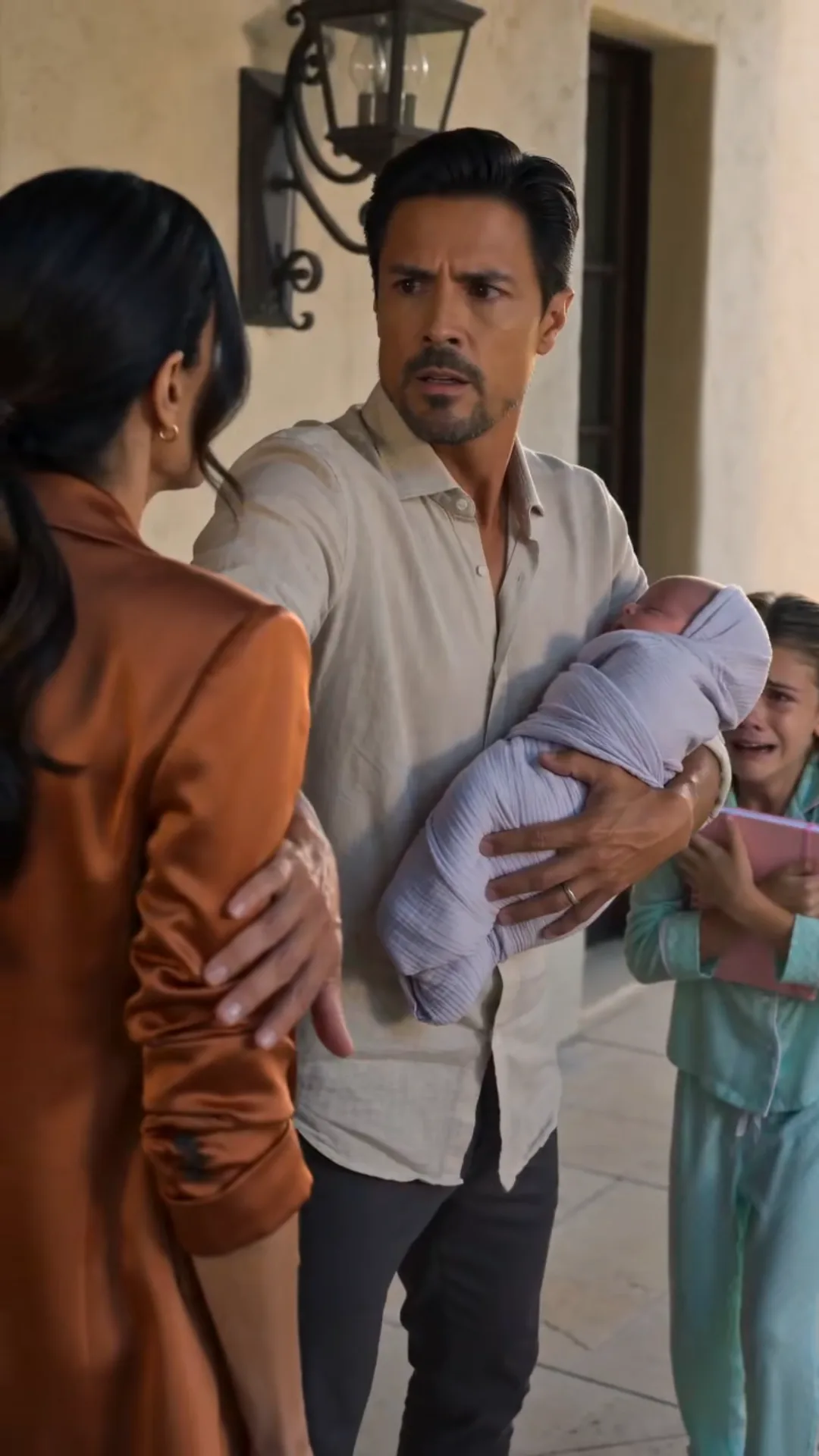
The morning it started — the actual morning, the one that would end in the hallway — began like any other.
Cereal. Cartoons murmuring low in the next room. Nora asleep in the bassinet, one small fist curled by her ear.
Mateo was looking for his car keys.
He was always looking for his car keys.
---
He found them, eventually, on the counter, beside the pink notebook.
Sofia had left it there. Uncharacteristic. She never left it anywhere unattended, not even to use the bathroom — she'd once brought it into the shower stall, wrapped in a plastic bag, "so it doesn't get lonely," she'd said, and he had laughed, charmed, missing the fear underneath the joke entirely.
But there it was. On the counter. Unattended.
Its little padlock sticker faced up at him.
Private. Do not touch. Emergency only.
He almost touched it. His fingers actually grazed the cover.
Then Renata's voice came from the hallway — Mateo, have you seen the diaper bag? — and he pulled his hand back like he'd been caught doing something wrong, though he couldn't have said, at the time, what exactly.
He would replay that moment more than any other in the months to come.
The half-second his fingers touched the cover.
The half-second he let go.
---
Sofia found the notebook back in her room that evening, exactly where she'd left it, not one page disturbed.
She didn't know her father had almost opened it.
She only knew, with the peculiar sharpness children develop when their safety depends on reading rooms correctly, that something in the apartment had shifted that day. A tightness. A held breath.
She heard Renata and Mateo through the wall that night — not shouting, never shouting, just the low, urgent register adults use when they think children are asleep.
She caught fragments.
...don't know why she's suddenly so...
...you're imagining things, Mateo, she's seven, she's dramatic...
...I just want to understand why my daughter is scared of...
The sentence ended there, cut off, or maybe Sofia simply fell asleep before hearing the rest, the way children's bodies sometimes protect them from information they aren't yet equipped to carry.
---
The next few days moved differently.
Mateo started coming home earlier.
He started, without announcing it, spending more time in the same room as Sofia — not hovering, not obviously, but present, in the way a man is present when some old, buried paternal alarm has finally, quietly, started to ring.
Renata noticed.
Of course she noticed. She noticed everything that threatened the careful temperature of her rooms.
She became, in response, warmer than ever. Sweeter. She baked cookies with Sofia on Thursday, took a photo of the two of them mid-laugh, flour on both their noses, and posted it with a caption about blended families and second chances.
Mateo saw the photo before he saw his daughter that evening.
He remembered thinking: see, I was imagining things.
He did not know that forty minutes after that photo was taken, Renata had sent Sofia to her room for "getting flour everywhere," and that the sending had not been gentle, and that Sofia's elbow had caught the doorframe hard enough to bruise, and that Sofia had written, in tight, controlled letters that night: She only smiles when the camera is up. I checked. I counted. Six times this month, six smiles, six pictures. Zero smiles the rest of the time.
Seven years old, and she had already learned to build a case.
---
Friday came.
Mateo had a half-day at work, an old habit from before Renata, back when he used to pick Sofia up early sometimes just to get ice cream before the after-school rush.
He decided, spontaneously, sentimentally, to do it again.
He didn't tell anyone. He liked the idea of surprising her.
He signed her out of school at 1:15, and Sofia's face, when she saw him in the front office, did something he hadn tn't seen in months.
It cracked open.
Not into a smile, exactly. Into something rawer than that — relief, maybe, the specific relief of a person who has been treading water and suddenly feels sand under their feet.
"Dad," she said, and hugged him so hard around the waist that he laughed and asked if she'd missed him that much.
"You have no idea," she said, muffled, into his jacket.
He thought she was being cute.
He did not yet understand that she meant it as a factual statement.
---
They got ice cream. Sofia got two scoops of the birthday cake flavor, which she only ordered on good days, and ate it slowly, the way she used to before things had gotten complicated at home, savoring instead of just consuming.
"Dad," she said, licking a drip off her wrist. "Can I ask you something?"
"Anything."
"If you found out somebody was being mean to me — really mean, not just annoying-mean — what would you do?"
Mateo set down his own cone.
Something in his chest went very still, the way a house goes still right before a storm hits, that particular pressure-drop quiet.
"I would make it stop," he said, carefully. "Immediately. No matter who it was."
Sofia studied him. Weighing the sentence. Testing its weight against some private scale she'd built over the last four months.
"Even if it was someone you loved?"
"Especially then," Mateo said, and meant it more than he'd meant almost anything in his life. "Sofia. Is somebody being mean to you?"
She looked down at her melting ice cream.
For one full, unbearable second, Mateo thought she was going to tell him everything, right there, in a strip-mall parking lot, sunlight bouncing off the hood of the car, and some part of him braced for it, wanted it, needed the waiting to be over.
Then her phone — the small kids' watch Renata had bought her for "safety" — buzzed on her wrist.
A message from Renata: Where are you two? Nora has a doctor's appt in 30. Come home now please.
Sofia's face closed again. Efficiently. Like a shop pulling down its shutters at the first sign of trouble.
"No," she said. "It's nothing. I'm being dramatic. Renata says I'm dramatic."
"Sofia—"
"Can we go? I don't want Nora to be late."
---
Mateo drove home with a knot in his stomach he couldn't name.
He kept glancing at his daughter in the rearview mirror, at the careful blankness she'd arranged on her face, a blankness too controlled for a seven-year-old, a blankness he now recognized, retroactively, as something learned. Practiced. Necessary.
He did not know, yet, that this was the day everything would tip.
He did not know that in the apartment, waiting, Renata had already found the pink notebook where Sofia had, in her rush that morning, left it half-visible beneath her pillow.
He did not know that Renata had read four pages of it before hearing the car in the driveway and shoving it back exactly where she'd found it, her face rearranging itself, in the space of six seconds, from fury into something warm and welcoming and entirely, dangerously false.
He only knew, walking up to the door with his daughter's small, cold hand in his, that something in the air of his own home had changed.
Sharpened.
May you like



Like a held breath right before a scream.
---







