Chapter 4 - What the Baby Heard
The apartment was too quiet when they walked in.
Mateo noticed it in his shoulders first — a tightening, animal and pre-verbal, before his mind had even caught up to what his body already suspected.
Sofia noticed it too. He felt her hand go rigid in his.
---
Renata was standing in the kitchen doorway, holding Nora, her blazer still buttoned, her smile arranged with the precision of someone who has practiced a smile in a mirror.
"There you are," she said, warm as syrup. "I was starting to worry."
"We got ice cream," Mateo said. "Sorry, I should've texted."
"No, no. It's fine." Her eyes moved, briefly, to Sofia. Something flickered there — quick, cold, gone before Mateo could name it. "Sofia, sweetheart, why don't you go put your backpack away."
Sofia did not move.
Her hand tightened in her father's.
"Go on," Renata said, and her voice had dropped, almost imperceptibly, into a different register — a register Mateo had never quite consciously heard before, though some deep unconscious part of him had been cataloging it for months.
Sofia looked at her father.
Then at the hallway behind Renata.
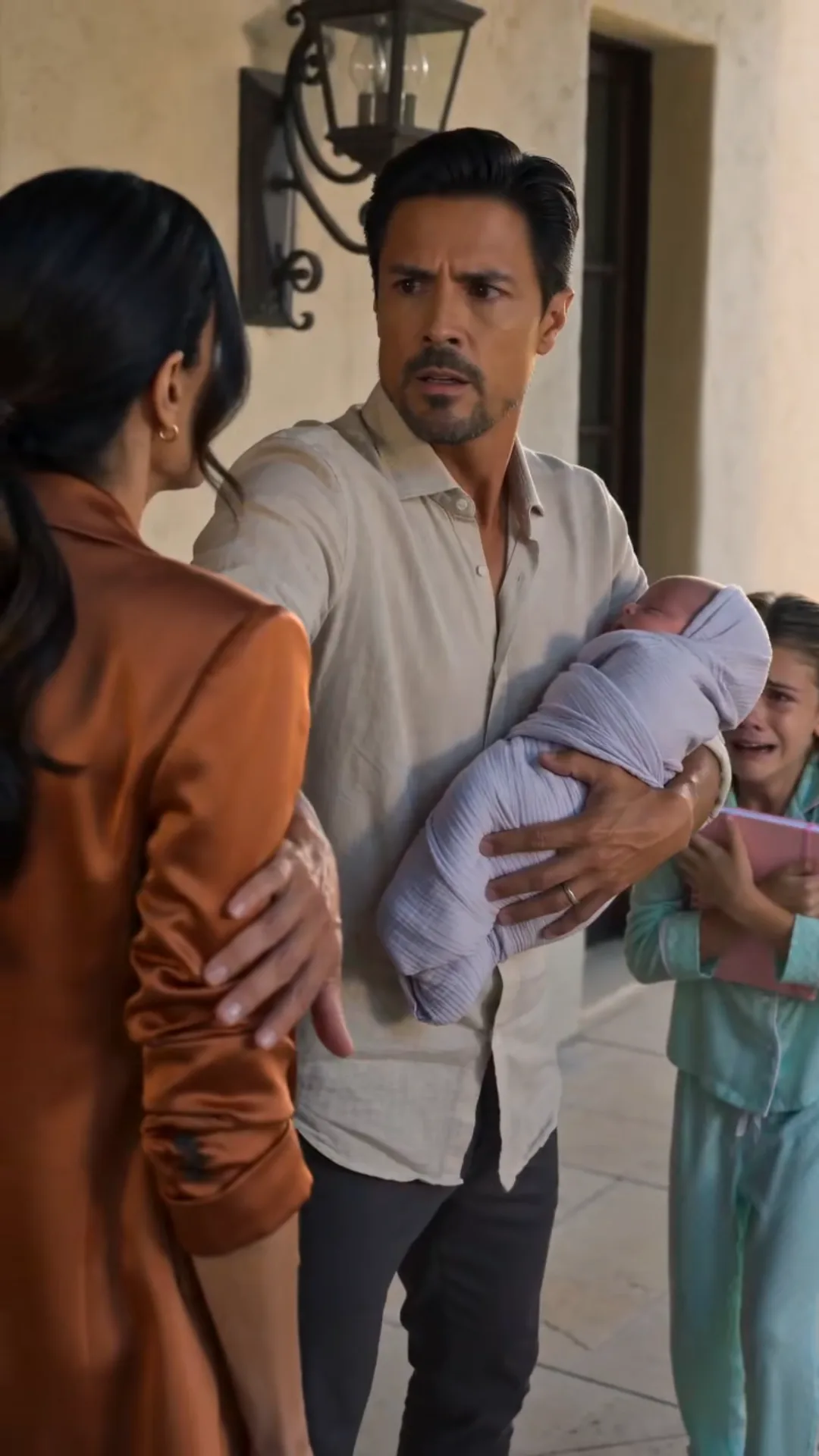
Then, very slowly, she reached into her backpack and pulled out the pink notebook, holding it against her chest with both arms, the way you'd hold something you were prepared to die defending.
---
"Sofia," Renata said. "Give me the notebook."
"No."
The word came out small. But solid. A door closing, once and for all, on months of silence.
"Sofia." Warning, now, thinly veiled beneath the syrup. "We talked about this. Give it here."
"No," Sofia said again, louder this time, and stepped backward into the hallway, putting distance between herself and the woman holding her baby sister. "It's mine. Mom gave it to me."
Something in Renata's face shifted then — not dramatically, not yet, but enough that Mateo, watching, felt the temperature of the room drop by several degrees.
"Her mother gave her that notebook," Renata said to Mateo, an appeal now, a reframing, spinning the moment even as it happened. "She's attached to it. It's a whole thing. I've told you about this."
She hadn't. Not once. Not really.
Mateo looked at his daughter, standing in the hallway with her back against the beige wall, arms wrapped around a spiral notebook like it was a life vest, and something that had been sleeping in him for four months finally, fully, woke up.
"Sofia," he said quietly. "Come here, baby."
She came to him. Fast. Like she'd been waiting months for someone to say those exact words in that exact tone.
---
He crouched down to her eye level, the way he used to when she was smaller, when the hardest thing in her world was a broken crayon.
"What's going on?" he asked. Not to Renata. To his daughter. Directly. For the first time in longer than he wanted to admit.
Sofia's chin trembled.
"Why are you scared of her?" he asked, and his voice cracked slightly on the word scared, because saying it out loud made it real in a way that no small brick, no broken clip, no relocated coat ever had.
---
"¿Por qué te tiene tanto miedo?"
He didn't even realize he'd switched to Spanish — the language of his own childhood, the language that came out of him unbidden in moments too raw for careful English. Why is she so afraid of you.
He asked it looking at Renata. Demanding. A father's question, finally, four months too late.
Renata's smile didn't move, but something behind her eyes went very flat.
"Solo está exagerando, Mateo," she said. Smooth. Practiced. She's just exaggerating.
The same three words she'd used in November, about the clip.
The same three words she'd used in December, about the coat.
Mateo heard them this time. Really heard them. Heard the pattern in them, the way you suddenly hear the tune buried inside static once someone points it out to you.
---
"Dad," Sofia said, and her voice cracked wide open, months of held breath finally, finally escaping. Tears came fast, the kind that had clearly been waiting behind a very thin dam for a very long time. "Dad, please. Please don't let her take it."
Her arms tightened around the notebook until her knuckles went white.
"I wrote it all down," she said, sobbing now, the words tumbling out in a rush, like water finally finding a crack in a wall it had been pressing against for weeks. "I wrote everything so you would know. Even if I couldn't say it. I wrote it so you would know."
"¡No dejes que me lo quite! Lo escribí todo para que lo supieras."
Mateo had heard his daughter cry before. Skinned knees. Lost toys. The specific grief of watching a balloon float away.
He had never heard this sound come out of her. This particular, ancient sound — the sound of a small person who has been alone with something too big for her, for far too long, finally setting it down in front of someone she trusted to pick it up.
He would hear that sound in his sleep for years.
---
Nora, in Renata's arms, began to cry too — startled awake by the noise, by the sudden electric tension in the hallway, the way infants cry not from understanding but from some older, wordless sensitivity to danger in the air.
The sound of the baby crying seemed to break something loose in Renata.
Her face — the careful, warm, practiced face she'd maintained for four months of small cruelties committed only where cameras and husbands couldn't see — finally, visibly, cracked.
What was underneath it was not warm.
---
"Give me that," Renata snapped, and the syrup was completely gone now, evaporated in an instant, replaced by something low and hard that Mateo had genuinely never heard from her before — or perhaps had heard, in fragments, through a bedroom wall, and told himself he'd imagined.
She lunged.
Not gently. Not a request. A grab, fast and sharp, aimed directly at the notebook clutched against his daughter's chest, her free hand snapping forward like a trap closing.
Sofia flinched backward, a full-body flinch, the flinch of someone whose nervous system had been rehearsing exactly this moment for months, whose body reacted before her mind even had time to be afraid.
---
Mateo moved without thinking.
His arm — the one not cradling his newborn daughter — shot out and caught Renata across the chest, solid, immovable, a wall where a moment ago there had only been a confused, exhausted, willfully blind man.
"Don't," he said.
One word. Low. Absolute.
The kind of word a man says only once in his life, at the exact moment he stops being able to look away from something.
---
Renata stared at him, chest against his forearm, breathing hard, and for a moment the whole hallway held its breath — baby crying, girl crying, man breathing through his teeth, woman searching his face for the crack she'd always been able to find and exploit before.
She didn't find it this time.
Something in Mateo had closed over, hard and final, like a door he would never again leave unlocked.
"Sofia," he said, without looking away from Renata. "Go to your room. Lock the door. I'll come get you in a minute."
Sofia ran.
Notebook clutched to her chest.
May you like



Shoes, still by the bed, forgotten, because for the first time in four months, she was running toward safety instead of preparing to run from its absence.
---







