Chapter 5 - Papá, Ella Mató a Mamá
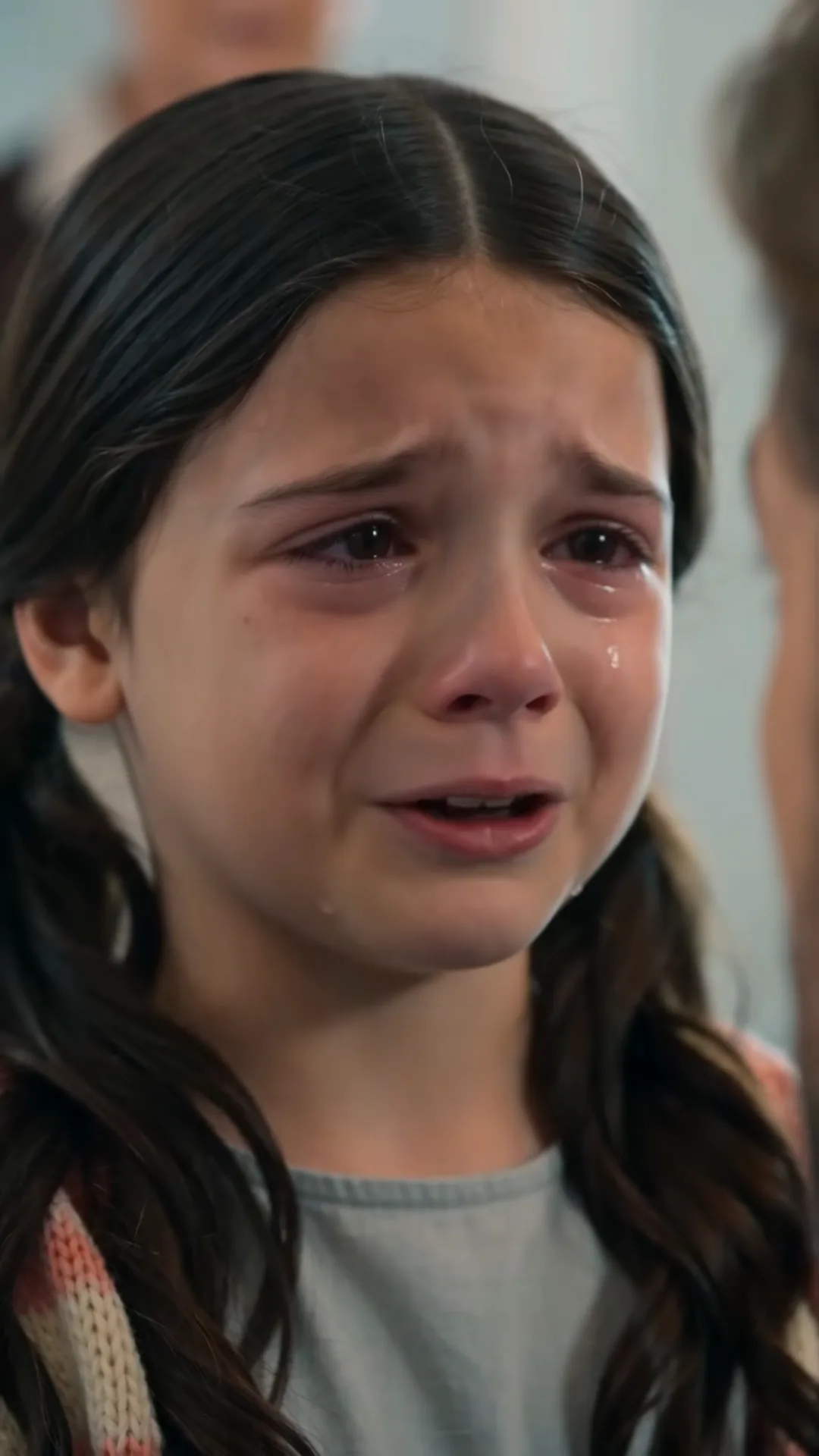
Nobody breathed.
Not Marisol, whose hand had frozen mid-motion on Sofia's shoulder. Not Valentina, whose lips had parted slightly around a word that never came. Not even the house itself seemed to breathe — no hum of air conditioning, no distant tick of a clock, just four human beings and one impossible sentence hanging in the cold bathroom air.
Mateo's hands were still cupping his daughter's face.
He didn't move them.
He couldn't.
---
"What did you say," he whispered.
Not a question, exactly. More like a man asking the universe to rewind itself, to give him a different four words to work with, any four words at all.
Sofia's lip trembled. Her eyes, impossibly, held steady on his.
"Ella mató a mamá," she said again, and this time her voice cracked directly through the middle of the sentence, grief and certainty tangled together in a way that made the words somehow more devastating, not less.
She killed Mom.
---
Mateo turned his head slowly.
Valentina had gone very still. Very pale, beneath her flawless makeup — pale in the specific way that isn't performance, that no amount of composure training can produce artificially.
"Valentina." His voice came out low. Dangerous in a way Sofia had never heard from her father before. "What is she talking about."
"Mateo, she's a child. She's confused. Grief does strange things to—"
"What is she talking about."
---
Valentina's hands found each other, fingers lacing together in front of her waist — the universal gesture of someone trying to physically hold themselves together.
"I don't know what she thinks she saw," Valentina said carefully. Too carefully. Each word placed like a chess piece. "Elena's death was an accident. The report was clear. She fell. She hit her head on the—"
"I know what the report said." Mateo's voice cut through hers like a blade. "I'm asking what my daughter is talking about."
---
Sofia's small hands gripped the front of her father's shirt, fistfuls of fabric, the way drowning children grip the nearest solid thing.
"I saw her," Sofia said, quieter now, but somehow more terrible for the quiet. "On the stairs. That night. I saw her."
Marisol made a small sound — not quite a gasp, something caught between shock and confirmation, like a puzzle piece she'd been holding for months finally clicking into a shape she'd feared but never let herself fully imagine.
---
"Sofia." Valentina's voice sharpened, the careful mask cracking at the edges. "You were asleep that night. You told the police you were asleep."
"I woke up."
The room went colder.
"I heard yelling. I came to the top of the stairs. I saw you."
Sofia's voice was steadying now, the way children's voices sometimes do when they finally release something they've carried alone for too long — the terror transforming, mid-sentence, into something closer to resolve.
"I saw you push her."
---
Valentina's face drained of every remaining trace of color.
"That's not — " Her voice cracked for the first time since Mateo had walked in. "That's not what happened."
"Then tell me what happened," Mateo said. He hadn't raised his voice. He didn't need to. Something in his tone had gone glacial, final, the voice of a man who had already begun, somewhere deep in his chest, to believe the worst.
---
The silence that followed stretched long enough that Marisol finally spoke, her voice trembling but steady, three months of swallowed suspicion finally finding a door to walk through.
"Señor Mateo. Puedo decir algo."
I can say something.
He nodded once, not taking his eyes off Valentina.
"La noche que murió la señora," Marisol continued, switching between Spanish and English the way people do under stress, reaching for whichever language gets the truth out fastest. "I heard them arguing too. From the kitchen. I didn't see anything. But I heard voices. Elena's voice, and hers." She nodded toward Valentina. "Loud. Angry. And then — nothing. Silence. And then the sound."
---
"What sound," Mateo asked, though some primal part of him already knew, had known for three months, had simply refused to let the knowledge fully surface.
Marisol's eyes filled with tears.
"The sound of someone falling," she said. "Down the stairs. I ran. By the time I got there, Elena was already—" Her voice broke completely. "She was already on the floor. And Valentina was standing at the top. Just standing there. Not screaming. Not calling for help. Just standing."
---
"That's not true," Valentina said, but her voice had lost all its polish now, all its careful architecture. It came out ragged. Desperate. "I called for help immediately. I was in shock. Anyone would be in shock."
"You waited," Marisol said quietly. "I don't know how long. But you waited before you called anyone. I saw the clock in the kitchen when I ran past it. And I saw it again when the paramedics arrived. Eleven minutes, Señorita Valentina. Eleven minutes you stood at the top of those stairs before anyone called for help."
---
Eleven minutes.
The number landed in the room like a stone dropped into still water, ripples spreading outward, touching every surface, every person, every assumption Mateo had built his grief around for the last three months.
He had been told his wife's death was instant. Painless. A tragic accident, quick and merciful, the only comfort anyone had been able to offer him in the horrific days that followed.
Eleven minutes was not instant.
Eleven minutes was an eternity, if there had been any chance at all that those minutes could have been the difference between a funeral and a hospital room.
---
"Was there a chance," Mateo said, his voice suddenly very quiet, very controlled, the calm of a man standing at the exact center of an emotional hurricane. "Was there a chance she could have survived, if you'd called immediately."
Valentina's silence answered the question more completely than any words could have.
"I don't know," she finally said. "I don't know if it would have mattered. I panicked. I didn't push her, Mateo, I swear to you, we argued, she turned to walk away, she was upset, she missed a step—"
"But you didn't call for help."
"I was in shock—"
"Eleven minutes is not shock, Valentina. Eleven minutes is a decision."
---
Sofia, still held against her father's chest, watched this unraveling with the strange, unblinking attention children sometimes bring to adult catastrophes — too young to fully process the legal and moral weight of what was happening, but old enough to understand, in her bones, that something enormous and true had finally broken through the surface of this house's careful silence.
She had carried this alone for three months.
Three months of nightmares she couldn't explain to anyone. Three months of flinching every time Valentina raised her voice, every time those manicured hands moved too quickly near her own small body.
Three months of being told, gently, by every adult around her, that what she'd seen that night was a dream, a trick of grief, a child's confused imagination trying to make sense of something too big to understand.
She hadn't been imagining it.
---
"I want you out of this house," Mateo said. His voice had gone completely flat now, stripped of every emotion except a terrible, exhausted clarity. "Tonight."
"Mateo, please—"
"Eleven minutes, Valentina." He rose slowly, lifting Sofia with him, her small arms wrapping tight around his neck, her face pressed into his shoulder, finally, finally allowed to stop performing composure for a room full of adults who hadn't believed her. "You get to explain that to a detective. Not to me."
---
Marisol was already reaching for the phone on the counter — not the curling iron, the actual telephone mounted on the wall, an old habit from a house that had, until recently, still believed in landlines for emergencies.
Her fingers trembled as she dialed.
May you like



Valentina stood frozen in the center of the marble bathroom, the room she had once controlled so completely, watching the careful architecture of her life collapse in real time, undone entirely by four words spoken by a seven-year-old girl who had finally stopped being afraid of the silence.
---







