Chapter 4 - Half a Sandwich
Thursday's lunch period, one week after the book report, found Malik and Tyler at their usual table near the cafeteria's east windows, a spot they had claimed by accident in September and defended by habit ever since.
Malik's lunch that day was half a peanut butter sandwich and an apple with a soft brown spot he was carefully eating around. His mother had come home from a night shift at six that morning, exhausted past the point of grocery shopping, and Malik had learned, over the years, to make do with whatever the kitchen actually contained rather than what a lunch was supposed to contain.
Tyler had a lunch packed by the woman who cooked for his family three days a week, in a container with individual compartments for the sandwich, the fruit, and a small container of ranch dressing for the vegetables nobody in his family particularly liked but everyone was required to eat two bites of.
Neither boy commented on the difference. It had simply become part of the landscape of their friendship, the way you stop noticing the color of a room you sit in every day.
"You okay?" Tyler asked, around a mouthful of sandwich. "You've been weird since the book report thing."
"I'm fine."
"You always say that."
"Because it's usually true."
Tyler considered this with the particular directness of an eleven-year-old who has not yet learned to let uncomfortable observations pass unspoken out of politeness.
"It wasn't fair, what she said. About you not writing it."
"She didn't technically say that."
"She basically said that."
Malik looked up from his apple, surprised — not that Tyler had noticed, exactly, but that Tyler had said it out loud, plainly, without the careful hedging most people used around subjects like this, the hedging that let uncomfortable truths hover in a room without ever quite landing anywhere solid enough to be addressed.
"Yeah," Malik said, quietly. "She basically did."
"Does she do that a lot? Stuff like that?"
Malik thought about the notebook in his backpack, the receipts, the small accumulating ledger of proof he had never shown anyone, not his mother, not Tyler, not a single living soul, because showing it would have meant explaining why he needed it in the first place, and explaining that felt, somehow, like handing someone a map to a wound he'd rather they simply not know the shape of.
"Sometimes," he said, which was true, and also the smallest possible version of the truth available to him.
Tyler did not push further. This, too, was part of what Malik valued about their friendship — Tyler asked questions and then, crucially, knew how to sit quietly with whatever answer he got, rather than mining it for more than a person was ready to give.
They talked about other things for the rest of the period. A video game update. A soccer match Tyler's team had lost the previous weekend by a single goal he was still, three days later, taking somewhat personally. Whether the cafeteria's pizza day was actually better than its taco day, a debate the two of them had been having intermittently since September with no resolution in sight.
It was, on the surface, an entirely ordinary lunch period between two entirely ordinary eleven-year-old boys.
Malik walked back to Room 214 that afternoon carrying, alongside his backpack, a small and specific dread he could not fully name — not fear, exactly, nothing so dramatic. More like the particular unease of a person who has learned to read weather patterns and does not like the shape of the clouds currently gathering, even though nothing concrete has happened yet to justify the unease.
He had, in fact, done everything right that week. Homework complete and turned in early. Reading double-checked. The specific advanced vocabulary word from the book report retired for the time being, replaced with plainer language he suspected would draw less attention.
He had, in the language of his own private notebook, kept every receipt current.
It did not matter.
This is, in the end, one of the harder truths this story has to tell, and it is worth saying plainly rather than letting it hover unaddressed the way Mrs. Pierce preferred to let her own worst instincts hover: a child's perfect behavior does not, in fact, protect that child from an adult who has already decided, somewhere below the level of conscious thought, that the child represents a problem requiring correction rather than a person requiring patience.
Malik's careful strategy — the notebook, the double-reading, the retired vocabulary word — had been built on the hopeful, understandable, and ultimately incorrect assumption that Mrs. Pierce's behavior toward him was a response to something he was doing, something that could therefore be fixed by doing differently.
It was not a response to anything he was doing.
It had never been about him at all, not really — not about his effort, not about his reading comprehension, not about whether he had genuinely written his own book report. It was about twenty-two years of a woman's unexamined resentment finally finding, in the smallest and least deserving target available to it, a place to land.
He did not know this yet, not with the clarity this story affords its reader. He only knew, sitting back down at his desk that Thursday afternoon for the final period of the day, that his stomach held a specific, low-grade unease he had learned, over two months, not to ignore.
He reached into his backpack, not for the notebook this time, but simply to touch it, the way you touch a smooth stone in your pocket for reassurance rather than for any practical purpose.
Two desks over, Tyler settled into his own seat, glanced once at Malik with the small, easy chin-nod that had become their entire private language, and had no way of knowing that within the next twenty minutes, he was going to say a sentence out loud, in front of an entire classroom, that neither he nor anyone else in that room would ever be able to fully unsay.
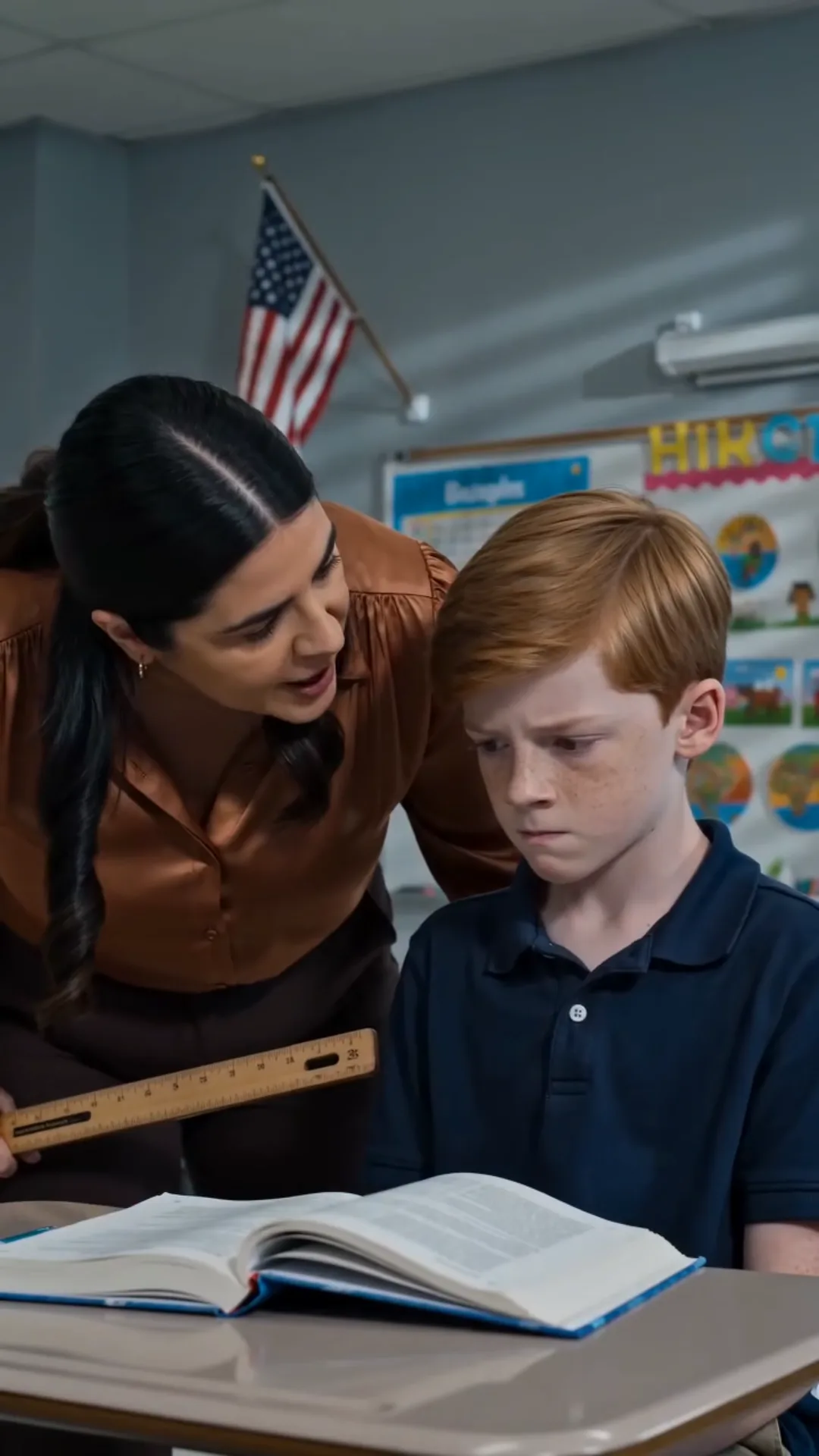
Mrs. Pierce walked to the front of the room, wooden ruler already in hand, and began the day's final lesson with the same crisp, practiced authority she had brought to every lesson for twenty-two years.
Nobody in Room 214, watching her begin, could have told you that this particular Thursday afternoon was going to be different from any other.
The weather does not announce itself, in a room like this one, until the exact moment it breaks.
May you like



Malik would think, much later, about how ordinary that final lunch period had felt — half a sandwich, a soft-spotted apple, a debate about pizza versus tacos that neither of them would remember starting. He would think about how little warning an ordinary Thursday actually gives you, how thin the membrane is between a day that ends in nothing and a day that ends up reshaping the rest of your life, and how you almost never get to know, standing inside it, which kind of day you're currently living through until it has already decided for you.
---







