Chapter 6 - Are You Seriously
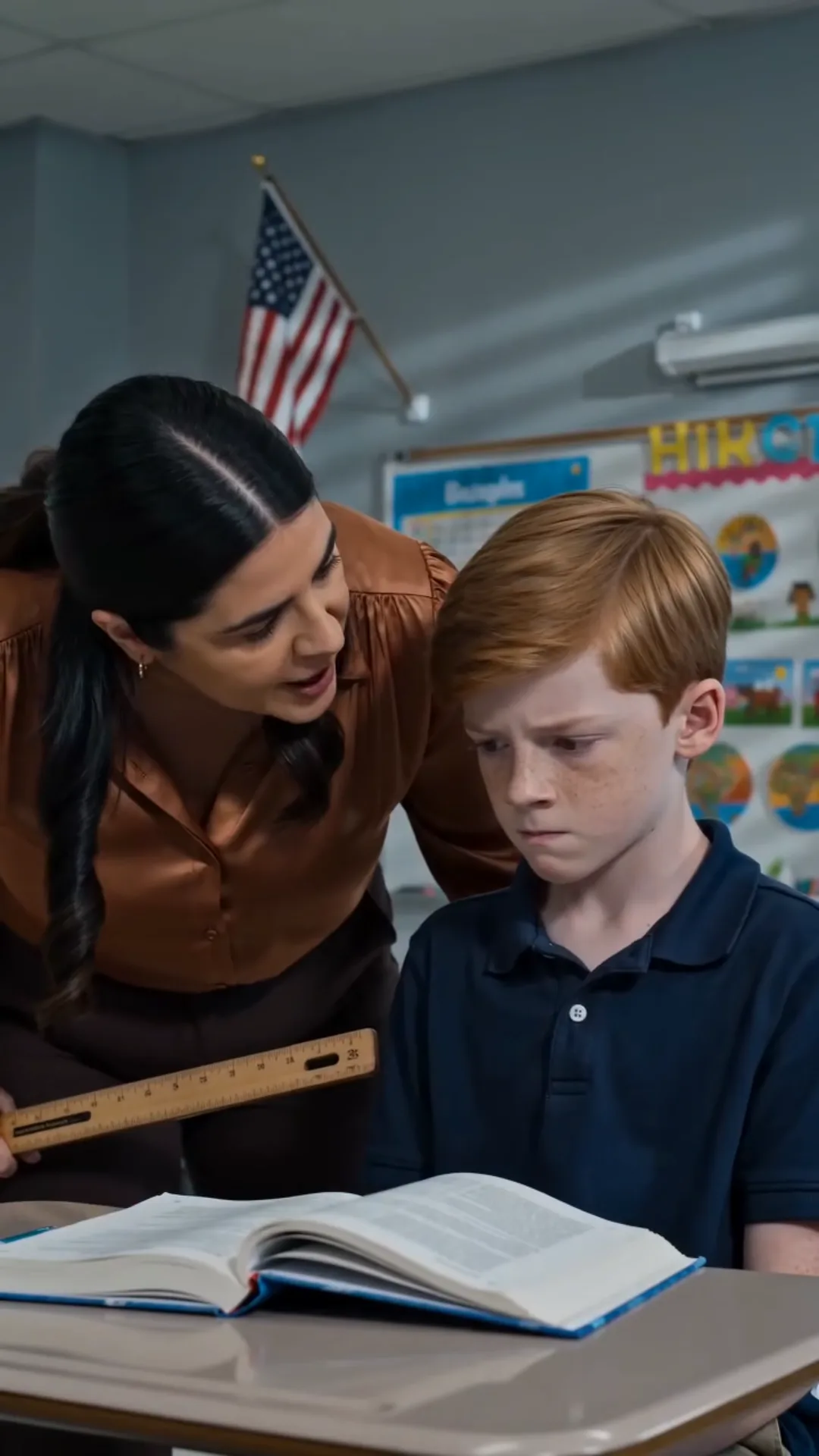
"Are you seriously discriminating against him?"
The sentence came out of Tyler Doyle louder than he meant it to, his voice cracking slightly on the word seriously in the specific way an eleven-year-old's voice cracks under weight it has never had to carry before, and it landed in the silent classroom with the force of something that could not, once said, be quietly folded back up and put away.
Mrs. Pierce turned. Her face had gone very still, the particular stillness of a person absorbing a challenge she had not braced for, from a direction she had not thought to guard.
"Excuse me?"
"You just told him to go to a different school. Because he's Black. That's discrimination. That's literally what that word means."
Tyler's freckled face had gone red, blotchy at the cheeks, his hands gripping the edge of his desk hard enough that his knuckles had paled, but his eyes did not drop, did not waver, held steady on Mrs. Pierce's face with a directness that most adults in that building had never once had to receive from a sixth grader.
"I did no such thing," Mrs. Pierce said. "I was addressing his academic dishonesty."
"You said 'go to a school for black kids.' Everyone heard you. I heard you. He heard you."
He gestured, without quite meaning to, toward Malik, who sat two desks over with his hands still curled in his lap, tears still wet on his face, watching this unfold with an expression that held, in roughly equal measure, gratitude and terror — gratitude that someone had finally said the thing out loud, terror at what saying it out loud was clearly about to cost.
"I will not be spoken to this way by an eleven-year-old," Mrs. Pierce said, and something in her voice had shifted, the careful, controlled register cracking into something sharper, more exposed, the sound of a person who has just watched her own authority take a hit she did not expect it to be capable of taking, in front of an entire room of witnesses she could not later pretend hadn't been there.
"Then don't say things you don't want repeated," Tyler said.
It was, by any measure, an extraordinary sentence for an eleven-year-old to produce under pressure, and Tyler himself would spend a long time afterward wondering where exactly it had come from, since he had certainly never rehearsed it, had never imagined, before that Thursday, that he would ever need a sentence like it available to him.
The truth, though he would not have been able to articulate it this way at the time, was that the sentence had not come from careful preparation at all. It had come from the accumulated weight of a week's worth of small, unresolved observations — the book report, the homework double standard, the specific look on Malik's face two desks over — finally finding, in one unbearable moment, a place to discharge themselves.
Mrs. Pierce's hand tightened around the wooden ruler.
She crossed the room — not toward Malik this time, but toward Tyler, and the rest of the class watched her come the way you watch weather approaching on a radar screen, with the specific, helpless dread of people who understand a thing is heading directly for them and have no way to stop its arrival.
She stopped behind his chair.
Close. Looming, the way she had loomed over Malik minutes earlier, the ruler held loosely in one hand at a height that made every student in that room understand, without her needing to say it explicitly, exactly what the ruler was there to communicate.
Tyler's lips pressed together, hard, a thin white line, his whole body gone rigid in the specific way a body goes rigid when it has decided to hold its ground and is discovering, in real time, exactly how much that decision is going to cost.
"Sit down," Mrs. Pierce said, "or you won't get a final grade."
The threat was, on its face, almost absurd — a grade, weighed against what had just happened to Malik, against the sentence that could not be unsaid, against the visible tremor still running through a crying eleven-year-old's shoulders two desks away — and yet it landed with real weight, because Tyler understood, even at eleven, that a failing grade in sixth grade was not really about sixth grade at all. It was about the kind of permanent record adults were always vaguely threatening children with, the invisible ledger that supposedly followed you forever, the kind of consequence designed specifically to make silence feel like the more reasonable choice.
Tyler was already sitting down. He had not, in fact, stood up at any point.
But he understood the threat was not really about his posture. It was about compliance — general, total, immediate — and it was aimed not only at him but at every other student in that room who might have been considering, in the charged silence following his outburst, whether to add their own voice to his.
Nobody else spoke.
Tyler sat very still, jaw tight, staring straight ahead at the open textbook on his desk, its pages still turned to the persuasive-writing unit that had started this entire unbearable sequence of events, and he felt something settle over him that he did not yet have a name for — not fear exactly, though fear was certainly present, curled tight beneath his ribs.
Something closer to resolve.
He had said the sentence. He could not unsay it, and some part of him, sitting there with his lips pressed white and his knuckles pale against the edge of his desk, did not want to unsay it even if he could have.
But saying it out loud, he understood now, had not actually stopped anything. Mrs. Pierce had absorbed the accusation and simply redirected her authority toward silencing the person who'd made it, the same way water redirects around an obstacle rather than being stopped by it, and Tyler understood, with a clarity uncomfortable for an eleven-year-old to sit with, that a sentence alone — however true, however brave — was not, by itself, going to be enough.
He needed something Mrs. Pierce could not later explain away with careful, deniable phrasing.
He needed something that did not depend on anyone believing his word against a teacher's.
Across the room, Malik had gone very still, watching Tyler's face with an expression that mixed gratitude with a new, sharper kind of fear — the fear, specifically, of watching someone take a risk on your behalf and having no way to protect them from the consequences of it.
He wanted, more than almost anything he had ever wanted in Room 214, to tell Tyler to stop, to sit back and let it go, to not risk whatever was clearly at stake in Mrs. Pierce's tightened grip on that ruler.
He said nothing. His voice, in that moment, still belonged to the shock of the last several minutes and had not yet returned to him.
Mrs. Pierce straightened, satisfied, apparently, that the classroom had been sufficiently restored to order, and walked back toward the front of the room, ruler swinging loosely at her side, already reaching for the lesson plan she intended to resume as though the last ninety seconds had been nothing more than a brief, forgettable interruption.
She did not see Tyler's hand move, slow and deliberate, toward the front pocket of his backpack.
May you like



She did not know, walking away, that she had just given two eleven-year-old boys exactly the window they needed.
---







