Chapter 7 - The Window
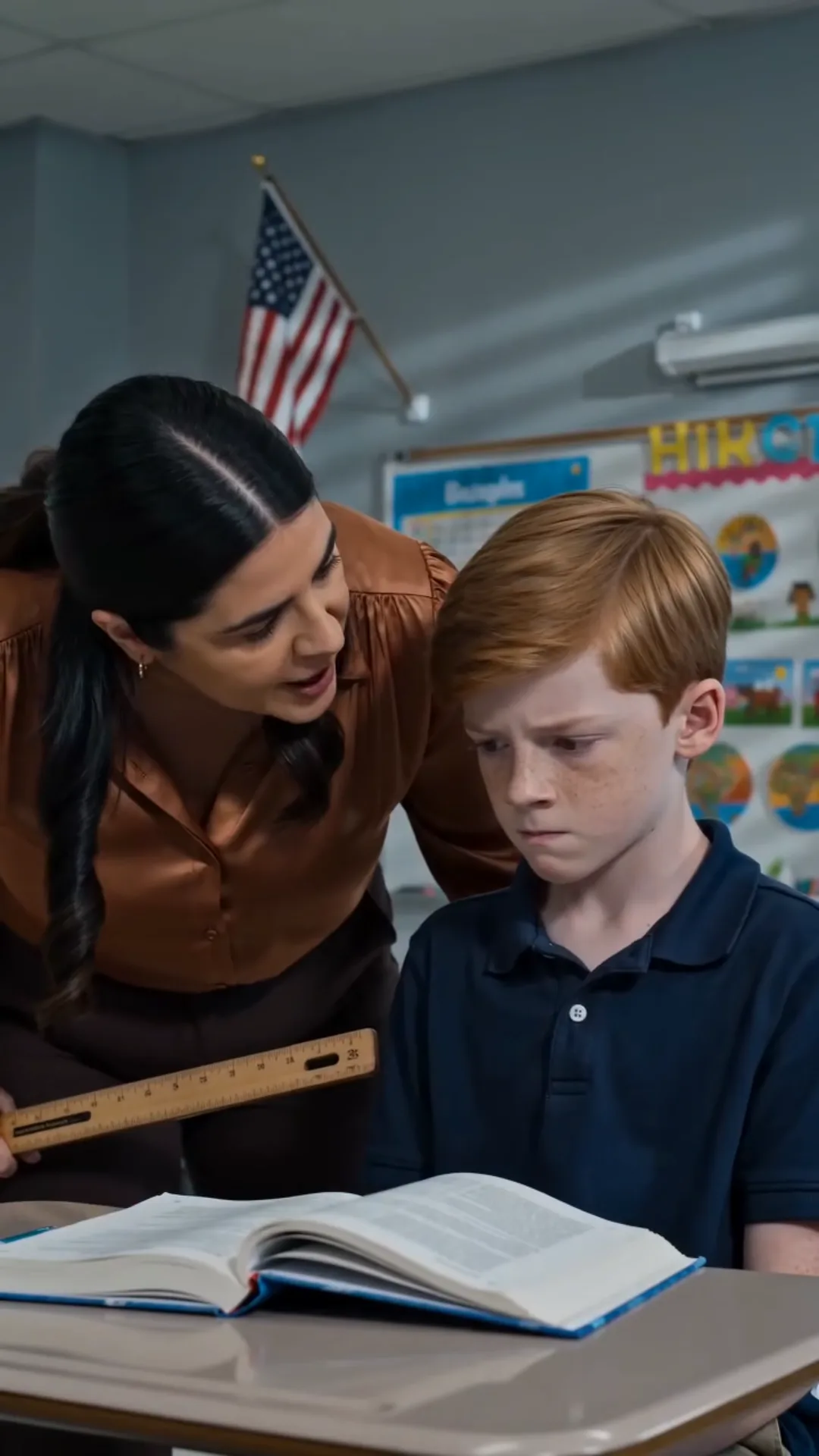
Mrs. Pierce did not make it all the way back to the front of the room.
She stopped, three desks short of her own, and turned back toward Malik — not toward Tyler again, whose silence she had apparently decided constituted sufficient victory — but toward the boy whose homework, whose vocabulary, whose entire presence in that classroom had somehow, in the space of one Thursday afternoon, become the thing her twenty-two years of quiet resentment had finally chosen as its target.
"And you," she said, looking down at Malik, who still sat with his hands curled in his lap, his face blotched and wet, "will be seeing me after school. We need to discuss your attitude."
She had not raised the ruler. She held it loosely at her side, the way she always did, the way she would later insist, if anyone asked, that she had held it the entire time — an ordinary teaching tool, nothing more, its presence in her hand no more significant than a pen or a piece of chalk.
But she leaned down as she said it, the ruler rising slightly, unconsciously, in the specific way a hand rises when its owner is emphasizing a point without any awareness that the rising itself carries meaning — and for one full second, she stood there, looming over a crying eleven-year-old boy, wooden ruler lifted at her side, her face set in the particular expression of someone who believes, entirely, that she has done nothing wrong.
It was, Tyler would think later, the exact picture the whole last five minutes had been building toward. Every small unfair thing he had half-noticed for a week, every deniable sentence, every careful, hedged accusation — all of it distilled down into one still frame that anyone looking at it, without needing a single word of context, would understand immediately.
His hand was already in his backpack.
He had moved it there in the seconds after sitting back down, slow, careful, using the cover of his own desk and the general chaos of a shaken classroom to slide his phone free of its pocket and down into his lap, screen dark, thumb resting lightly against the side button, waiting.
He did not fully decide, in any conscious sense, to take the photo. Deciding would have implied a process, a weighing of consequences, the kind of deliberation an adult might engage in before doing something this risky.
What Tyler experienced instead was closer to reflex — the same reflex that makes a hand pull back from a hot stove before the brain has finished registering pain, the same reflex, in its own way, that had made Malik's hands curl protectively into his lap minutes earlier without any conscious command from him at all.
His thumb found the camera icon. His hand rose, quick, low, angled just enough to catch the tableau in front of him — Mrs. Pierce leaning over Malik's desk, ruler lifted at her side, Malik's tear-streaked face turned up toward her — and the shutter clicked.
The sound was small. A single, soft artificial click, the kind every phone in that classroom made a hundred times a day for a hundred forgettable reasons.
In the charged, over-alert silence of Room 214 that afternoon, it might as well have been a gunshot.
Tyler's hand was already back down at his side, phone dark again, tucked half beneath his own thigh, by the time Mrs. Pierce's head snapped up.
She had heard it. There was no way, in a room that quiet, that she could not have heard it.
"Who just took a picture?"
Her voice had climbed into a register none of the students in that room had heard from her before — not the careful, controlled tone she used for correcting behavior, not even the sharper edge that had crept in during her exchange with Tyler minutes earlier, but something closer to panic, the specific, unmistakable panic of a person who has just realized, in real time, that a version of the last five minutes now exists outside her own ability to control or later explain away.
Nobody answered.
"Put your phones on the desk. Now!"
Twenty-two phones — most of them tucked into backpacks per the school's official policy, a handful, like Tyler's, kept closer at hand against the rules for exactly the kind of ordinary reasons eleven-year-olds keep phones close at hand — began surfacing across the room, sliding onto desktops in a nervous, scattered chorus of small plastic sounds.
Tyler's heart was going so hard he could feel it in his throat, in his ears, in the specific tremor of his own fingers as he slid his phone out from beneath his thigh.
He had one photo. Already taken. Already, though he did not yet fully understand the mechanics of what he'd done, already safely stored on a device he had not yet handed anywhere near Mrs. Pierce's reach.
He needed, in the next several seconds, to decide what came next — whether to place the phone face-up, screen visible, evidence in plain sight for a teacher who might simply delete it before anyone official ever saw it, or whether to buy himself the smallest possible window of time to do something with that photo before it could be taken away from him entirely.
He thought, in the fraction of a second available to him, of his mother — not because she had any part in this classroom, but because she was the person whose face rose up automatically in his mind whenever he needed, urgently, to know what the right thing to do actually was.
He thought, immediately after, of Malik's mother, whom he had never met, a woman named Denise Owens who worked twelve-hour shifts at a hospital across the county line and had no idea, in this exact moment, that her son was sitting in a classroom with tears still wet on his face, thirty feet from a teacher demanding every phone in the room be surrendered.
He made his decision in less time than it takes to describe making it.
May you like



Under the desk, screen angled away from Mrs. Pierce's rapidly approaching path down the aisle, his thumb moved fast — faster than he had ever typed anything in his life, faster than any assignment, any video game, any ordinary Thursday text — pulling up a single contact he had used exactly twice before, both times for genuinely trivial reasons, and attaching, with hands that would not fully stop shaking for another hour, the one photograph that was about to change everything.
---







