Chapter 5 - The Ruler
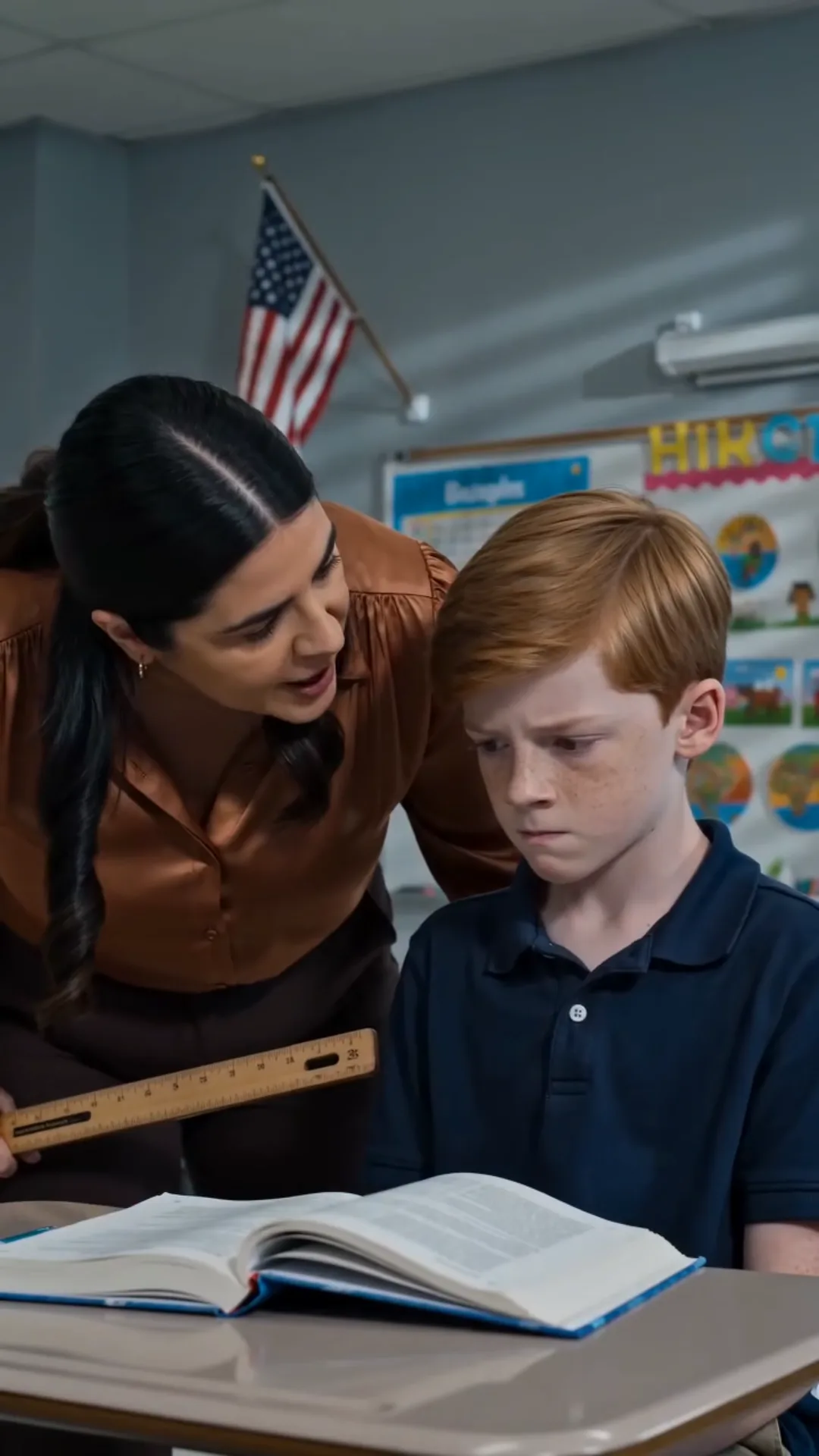
The lesson that Thursday afternoon was on persuasive writing, the same unit Room 214 had been working through for two weeks, and Mrs. Pierce had put a practice question on the board asking students to identify the strongest argument in a sample paragraph.
Malik raised his hand. He had read the paragraph twice, the way he read everything, and he was certain — not hopeful, not guessing, certain — of the answer.
Mrs. Pierce called on Chelsea Byrne instead, two rows over, who gave an answer that was close but not quite precise, missing the specific detail that made one argument stronger than the others.
"Almost," Mrs. Pierce said. "Anyone want to build on that?"
Malik's hand was still raised. He kept it raised, patient, the way he had trained himself to be patient, and after a pause just long enough to make clear it was a choice rather than an oversight, Mrs. Pierce finally pointed at him.
"Go ahead, Malik."
He gave the answer. It was correct — precisely, completely correct, using the exact language from the textbook's own definition of a strong argument, which he had memorized the previous week specifically because he had learned, the hard way, that being merely right was not always enough; being demonstrably, undeniably right was the only version of correct that reliably held up in that room.
Mrs. Pierce's face did something small and complicated.
"That's very close to how the textbook phrases it," she said. Her voice had gone careful in the particular way Malik had learned to dread more than shouting, the careful voice that was building toward something rather than settling into something.
"I read it a few times," Malik said. "I wanted to make sure I understood it right."
"Did you look at Chelsea's answer sheet?"
The question landed in the room like the wooden ruler was about to land on the desk a few seconds later — sudden, disproportionate, entirely unconnected to anything that had actually happened.
"No," Malik said. "I didn't. I don't have her—"
"Because that answer sounds suspiciously similar to what's written in the teacher's edition, which students don't have access to, which makes me wonder how you'd know to phrase it that precisely."
The room had gone quiet in the specific way a room goes quiet when every student in it recognizes, at the same instant, that something is happening that is bigger than the ordinary friction of a school day.
"I memorized the definition from the textbook," Malik said. His voice had started, despite every effort of will he had, to shake. "It's on page forty-one. I can show you."
"Sit up straight when you're talking to me."
He had been sitting up straight. He straightened further anyway, the way a body obeys a command before the mind has finished questioning whether the command made any sense, and it was in that exact moment — Malik straightening, hands flattening instinctively against the surface of his desk, bracing for whatever was coming next without yet knowing its shape — that Mrs. Pierce crossed the final distance to his desk and brought the wooden ruler down against it.
Chát.
The sound was enormous in that quiet room, far louder than a piece of wood striking a desk should reasonably be, the specific crack of twenty-two years of unexamined weather finally, catastrophically, breaking.
Malik flinched hard enough to knock his pencil off the desk. His hands, which had been flat against the wood, jerked back and curled instinctively into his lap, and his face — composed, careful, rehearsed for two months of small daily injuries — finally, entirely, gave way.
He did not sob loudly. He was not, by nature, a loud crier; he had learned, somewhere in the specific curriculum of being the only Black kid in Room 214, that loud crying drew a different kind of unwanted attention than quiet crying did.
But his eyes filled, and his shoulders curled inward, and a single tear traced down his cheek before he could stop it, and every single student in that classroom watched it happen in a silence that felt, to Malik, like the loudest sound he had ever not been able to hear.
Mrs. Pierce leaned down. Close, closer than any teacher should ever lean toward any student, her face inches from his, close enough that Malik could see the specific shade of her lipstick had bled slightly into the fine lines above her lip, close enough that the rest of the room fell away into the blurred, roaring periphery that fear produces around the edges of a person's vision.
"Why don't you go to a school for black kids?" she said. Her voice was low, meant for him alone, though the room was quiet enough that it carried further than she likely intended. "Why do you keep trying to get into a school like this?"
The words landed somewhere below the level of thought, in the same old, deep place where a body stores the memory of physical pain, and Malik would spend a long time afterward — years, in fact — trying and mostly failing to fully articulate what those two sentences had actually done to him, how a handful of words, spoken by a grown woman with a wooden ruler and twenty-two years of unearned authority, could carry more weight than the ruler itself had.
He said nothing.
There was, in that specific moment, nothing available to say. The strategy he had built over two months — the notebook, the receipts, the careful accumulation of proof that he belonged exactly where he was sitting — had no answer prepared for a sentence that did not argue with his qualifications at all, that simply, flatly, declared his presence itself to be the problem.
You cannot out-read your way past a sentence like that. You cannot memorize a definition precise enough to disprove it.
Two desks over, Tyler Doyle sat frozen, his own pencil forgotten between his fingers, watching his friend's face do something he had never seen a person's face do before — not simply cry, but seem to fold inward, to make itself smaller, as though the body itself had decided the safest response to the moment was to take up as little space in the room as physically possible.
Something in Tyler's chest — the small stone he had been carrying since the book report, the specific weight of a pattern he had spent a week half-convincing himself he'd imagined — stopped being a stone and became, instead, something closer to a fire.
He did not speak yet. The words were still assembling themselves, somewhere below conscious thought, in the same deep place where Malik's injury had just landed.
But he was no longer, in that instant, a boy who could simply sit and watch.
Mrs. Pierce straightened up, ruler still in hand, and turned to face the rest of the class as though nothing unusual had happened at all, as though the sentence she had just delivered had been an ordinary piece of classroom management rather than the exact moment this particular story would be built around for the rest of both boys' lives.
"Let's continue," she said. "Who else has an answer for question two?"
The room stayed silent for one more second.
May you like



And then Tyler Doyle's hand went up — not to answer the question about persuasive writing, but to ask one of his own, a question that would, in the next ten seconds, change the shape of everything that happened in Room 214 for the rest of that Thursday afternoon.
---







