Chapter 8 - Mom, Help
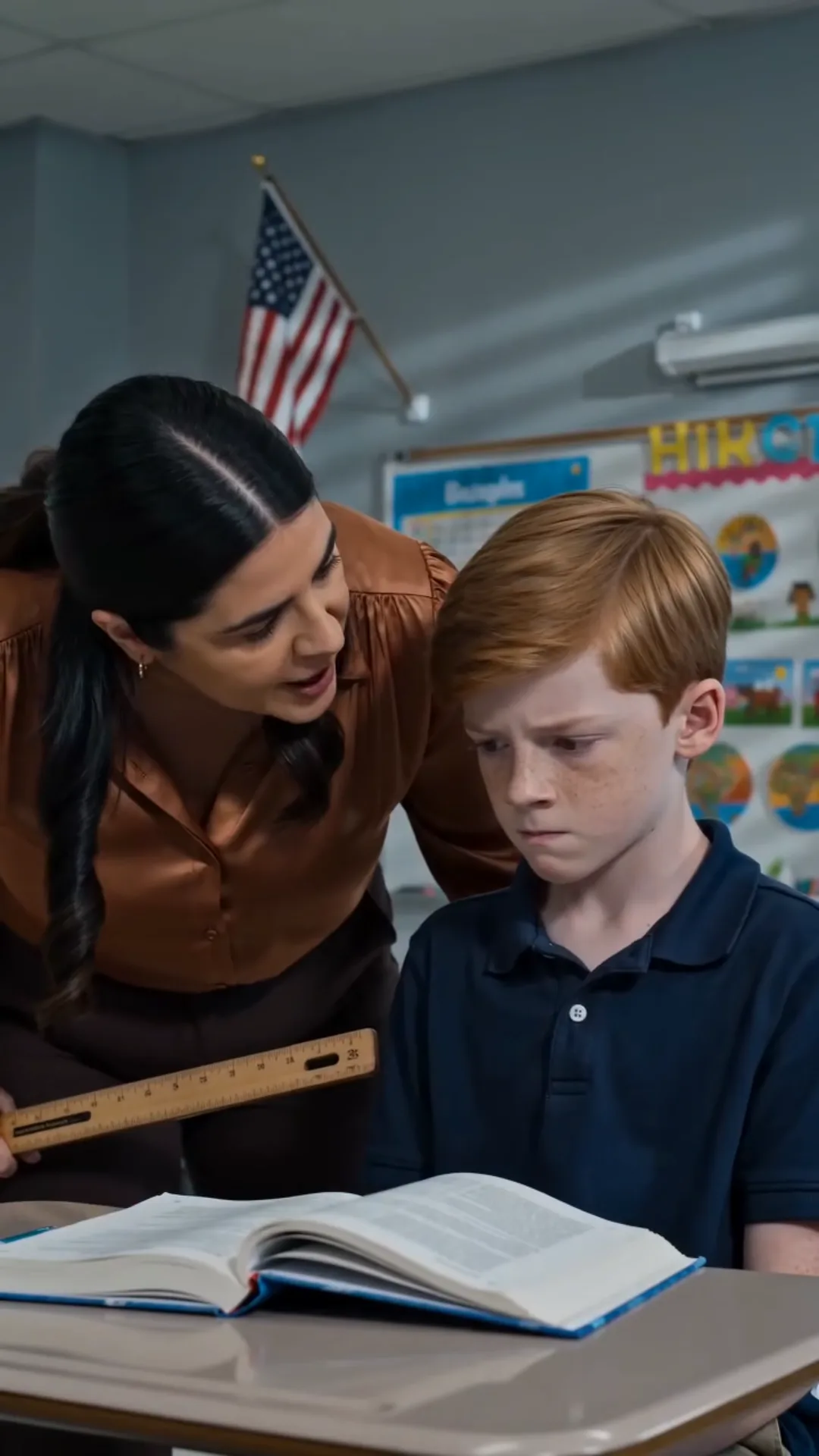
The contact said MOM, in capital letters, the way his phone had auto-formatted it the day his mother helped him set the device up two Christmases ago, and Tyler's thumb hovered over the photo for exactly as long as it took his brain to catch up to what his hands had already decided to do.
He typed six words. He would remember, for the rest of his life, exactly how few words it had taken.
Mom, help. My teacher is hurting Malik.
He hit send before Mrs. Pierce's shadow fell across his desk.
"Phone," she said, holding out her hand, her face still carrying the tight, controlled panic of someone who suspects the ground beneath her has already begun to shift and has not yet worked out how far the shifting is going to go.
Tyler set the phone face-up on his desk, screen already dark, the message already gone, already traveling through whatever invisible architecture carries a six-word plea from a classroom in Room 214 to a phone sitting in the pocket of a woman named Karen Doyle, three miles away, in the middle of an entirely ordinary Thursday afternoon grocery run.
Mrs. Pierce picked up the phone. She woke the screen, saw nothing but a blank lock screen with a soccer ball wallpaper, no visible photo, no visible message, and something in her posture loosened by a fraction, the loosening of a person choosing, gratefully, to believe the danger has already passed.
"I don't know what you thought you saw," she told the room, phone still in her hand, "but I will not have this classroom turned into a circus over one photograph of ordinary classroom management. Everyone, back to your seats. Books open to page forty-one."
She did not know page forty-one was the exact page containing the exact definition Malik had correctly recited fifteen minutes earlier, the definition that had started, in its own small way, the entire chain of events now unfolding around her.
She set Tyler's phone face-down on the corner of her desk, along with four or five others she'd collected in her sweep down the aisle, a small confiscated pile she intended to return, she announced, at the end of the period, once everyone had remembered how to behave like young ladies and gentlemen.
Malik sat very still through all of this, his tears finally slowing, his hands still curled protectively in his lap, watching Tyler across the two-desk gap between them with an expression that held something close to disbelief.
He did not yet know what Tyler had done. He had seen the phone rise, briefly, low and quick; he had heard the shutter click; he had watched Tyler's thumbs move fast beneath the desk in the charged seconds before Mrs. Pierce reached him.
But he did not know, sitting there, whether any of it had actually worked — whether the photo existed anywhere outside the confiscated phone now lying face-down on a teacher's desk, whether the six words Tyler had typed had actually reached anyone before the evidence could be quietly, permanently erased.
He would not find out until the end of the period, when Mrs. Pierce, distracted by the ordinary administrative business of collecting homework and preparing for dismissal, returned the small pile of confiscated phones without checking any of them more thoroughly than a glance at the lock screen — an oversight that would look, in hindsight, almost impossibly careless, though it was, in truth, exactly the kind of oversight busy adults make constantly, trusting a locked screen to mean nothing had happened behind it.
Tyler's hands shook retrieving his phone from the pile. He did not open it at his desk, did not risk drawing any further attention in the final ten minutes of class.
He waited until the bell rang, until the hallway outside Room 214 filled with the ordinary chaos of lockers slamming and backpacks swinging and two hundred kids simultaneously deciding this particular Thursday was, at long last, over.
He found Malik by the water fountain outside the cafeteria, the two of them pressed against the wall in a corner slightly out of the main flow of foot traffic, and he held out the phone, screen already unlocked, already open to the message thread.
Malik looked down at it.
The photograph filled most of the screen — Mrs. Pierce leaning over his own desk, ruler lifted at her side, his own face turned up toward her, blotched and wet, caught in exactly the moment he had felt, at the time, the most alone he had ever felt in his entire life.
Beneath it, in the small gray bubble of a sent text message, six words sat glowing on the screen, and beneath those, a second bubble had already appeared, gray-blue, timestamped four minutes earlier, from the contact labeled MOM.
What?? Where are you right now? I'm coming.
Malik read it twice, the way he read everything, and something in his chest — the specific, careful architecture he had spent two months building, the notebook, the receipts, the private theory that being perfect enough might someday be sufficient armor — came apart, quietly, in the school hallway, in a way that had nothing to do with the fear he'd felt in Room 214 an hour earlier.
"You texted your mom," he said. His voice came out smaller than he meant it to.
"Yeah."
"Why?"
Tyler looked at him with the particular bafflement of someone being asked to explain a decision that had not, in the moment, felt like a decision at all.
"Because what she did was wrong," Tyler said, "and I didn't know what else to do that would actually work. Words didn't work. She just told me to sit down. But a picture—"
He stopped, searching for the rest of the sentence, and found it in the specific, unpolished language of an eleven-year-old discovering, in real time, a truth many adults spend entire careers failing to learn.
"A picture can't tell you to sit down," Tyler finished. "It just sits there being true."
Malik did not say anything for a long moment. He looked down at the photograph again — at his own crying face, at the ruler lifted above him, at proof, undeniable and photographic, of something he had spent two months trying to document in a small spiral notebook that nobody but him would ever have believed.
"Thank you," he said finally, and the two words carried more weight than either boy, standing by that water fountain in a suddenly emptying hallway, fully had the vocabulary yet to measure.
Behind them, unheard by either boy in that moment, Tyler's phone buzzed again in his hand — a third message from the contact labeled MOM, sent from a car already turning, at that exact moment, into the Ashford Preparatory Academy parking lot.
May you like



I'm here. Come to the front office. Bring Malik.
---







